How do matching funds and in-kind contributions work?
Updated Oct 1, 2026 · program facts link to dataset records
What are matching funds?
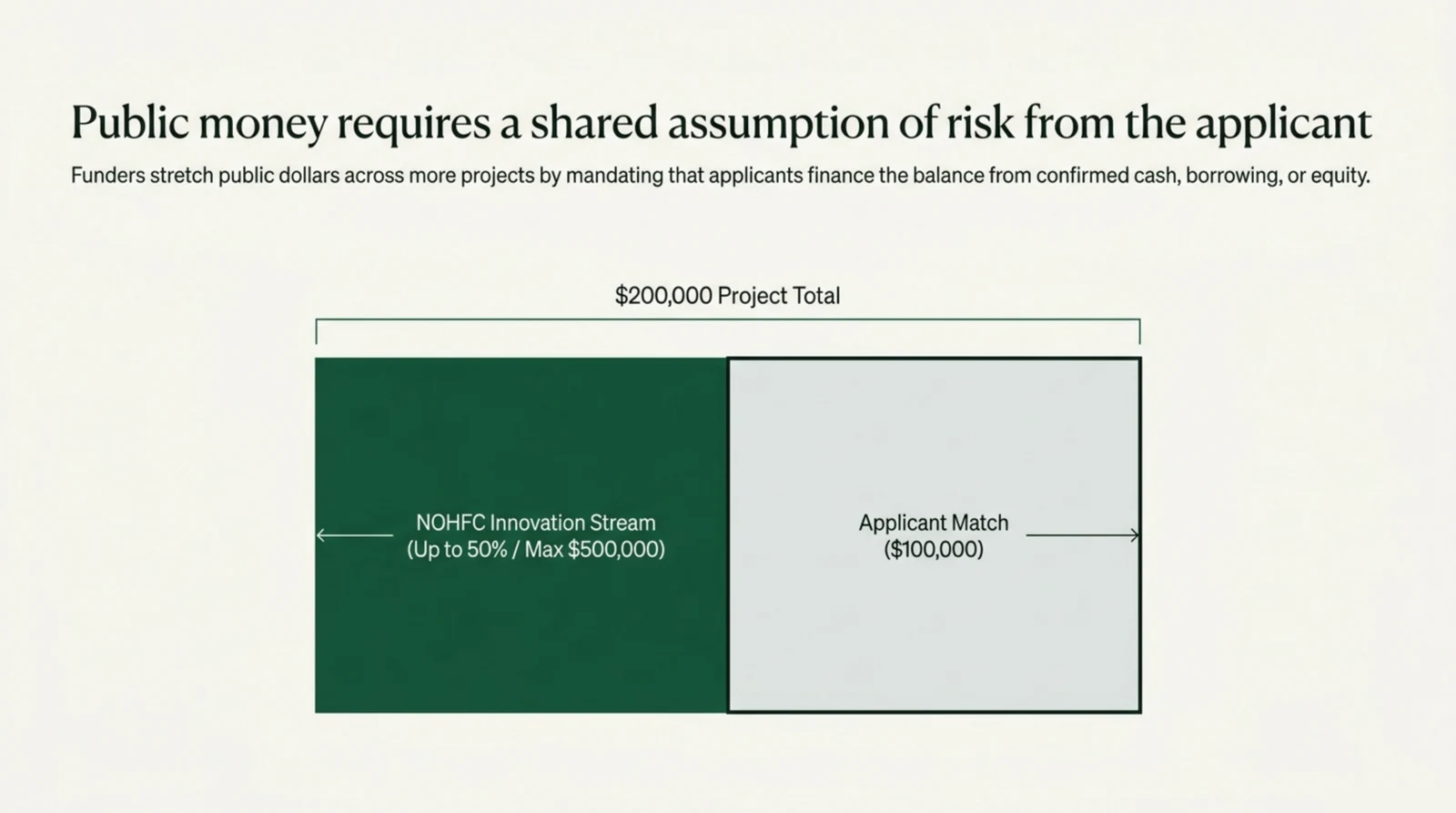
Matching funds are the share of project costs you bring yourself. Most Northern Ontario grant programs pay a percentage of eligible costs, commonly between 30 and 90 per cent, and require you to fund the balance from cash, borrowing or other confirmed sources. The NOHFC Innovation Stream, for example, covers up to 50 per cent of eligible costs, so a $200,000 project needs roughly $100,000 from you and other sources.
Funders require matching for two reasons: it stretches public money across more projects, and it shows the applicant is committed enough to share the risk. The match can come from several places, and understanding what counts, and what each program excludes, is the difference between an approvable budget and a rejected one.
What counts as matching funds?
Cash is always the cleanest match: money in the business, owner equity injections, or confirmed financing. Borrowed money generally counts as your contribution because you repay it, so a bank loan or a Community Futures loan, commonly available up to $150,000, can supply the match for a grant application. Confirm with each funder how it treats each source.
Typical acceptable sources:
- Cash on hand, shown through bank statements
- Term loans and lines of credit, shown through approval letters; northern options include CFDC loans, Waubetek financing in north-eastern Ontario, NADF financing within its service area, and the Métis Voyageur Development Fund, which lends up to $1,500,000 anywhere in Ontario
- Other grants, within stacking limits (covered below)
- Owner or member equity, including new capital you put in for the project
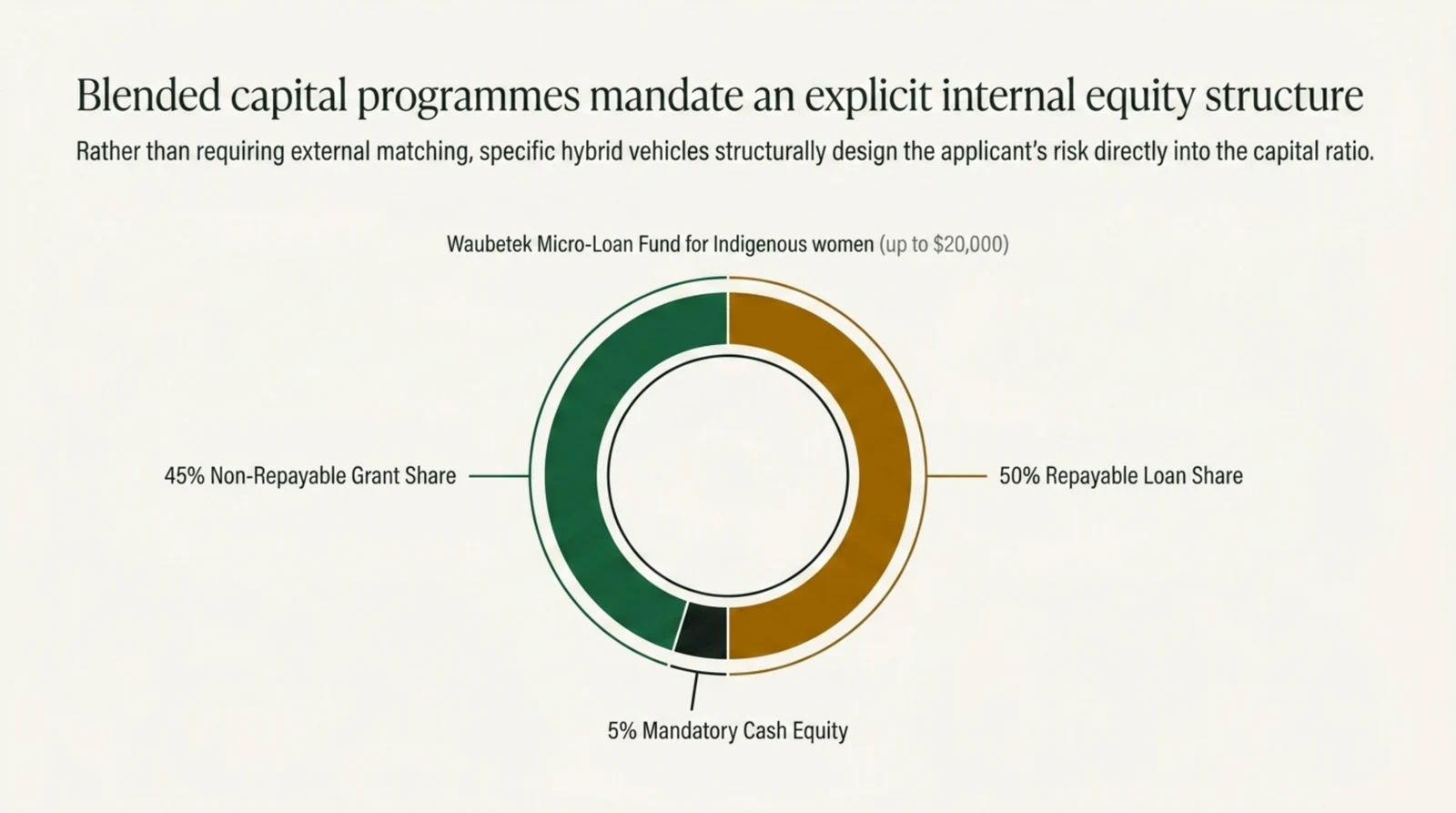
Watch the structure of blended programs. Waubetek's Micro-Loan Fund for Indigenous women, for instance, is built as 45 per cent non-repayable, 50 per cent repayable and 5 per cent cash equity on loans up to $20,000, so the equity requirement is explicit in the design.
What counts as an in-kind contribution?
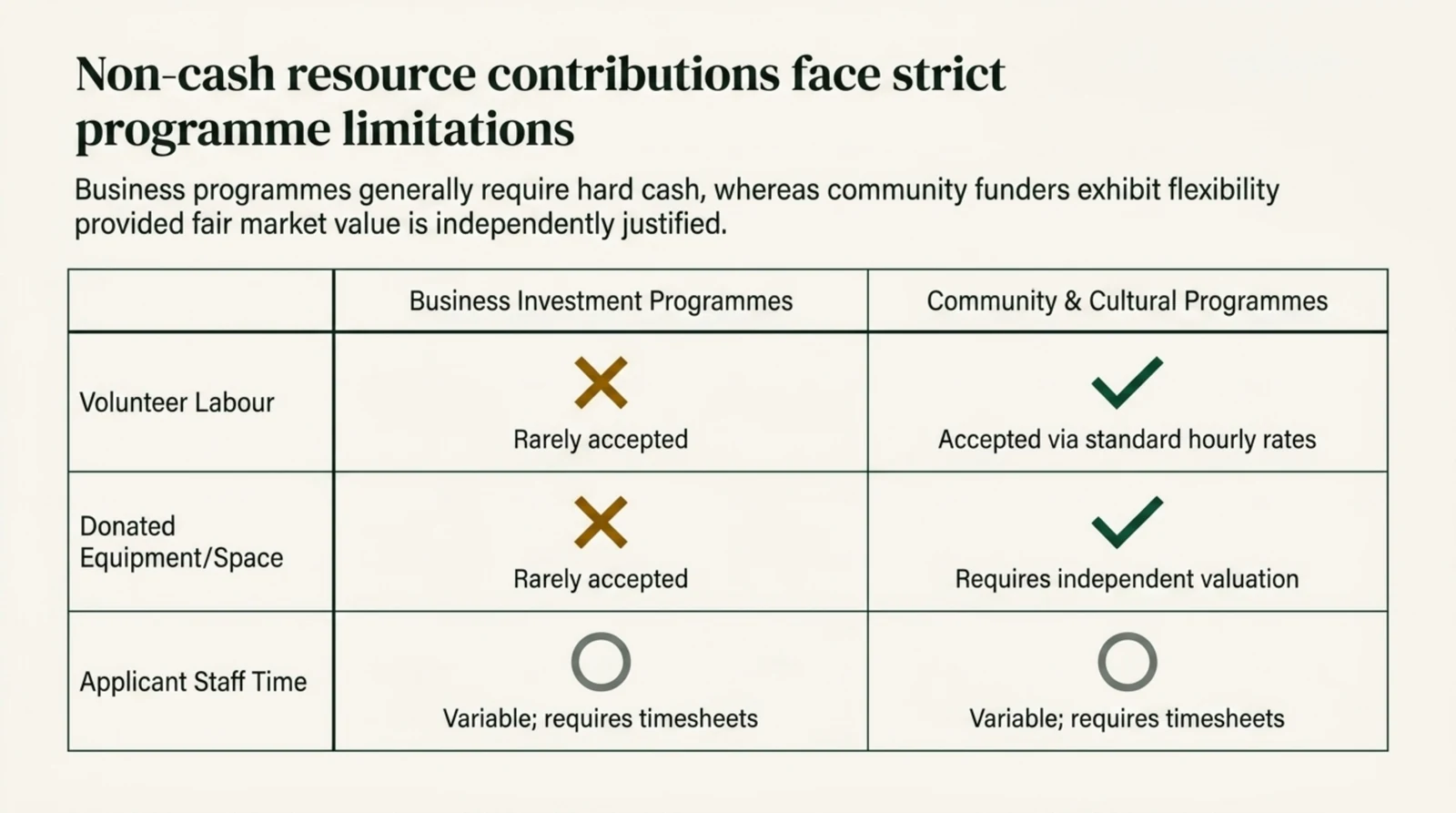
In-kind contributions are non-cash resources you put into the project: donated materials, professional services provided free, volunteer labour, or use of your own equipment and space. Some programs count them toward your match at fair market value, many cap them at a percentage of the project, and business-investment programs often do not accept them at all. Always verify the program's in-kind rules before building them into a budget.
General practices, which vary by funder:
- Value everything at fair market value and be ready to justify the rate, for example a contractor's normal hourly rate for donated labour
- Volunteer time is commonly valued at a standard hourly rate set by the funder; community programs are the most likely to accept it
- Your own staff time counts in some programs and not others; where it counts, it usually needs timesheets
- Land, equipment use and donated space typically need an independent basis for the value claimed
Community and cultural funders tend to be the most flexible on in-kind, and capital and business programs the least. If in-kind is central to making your budget work, confirm the rules in writing with the program officer first.
How much matching do Northern Ontario programs require?
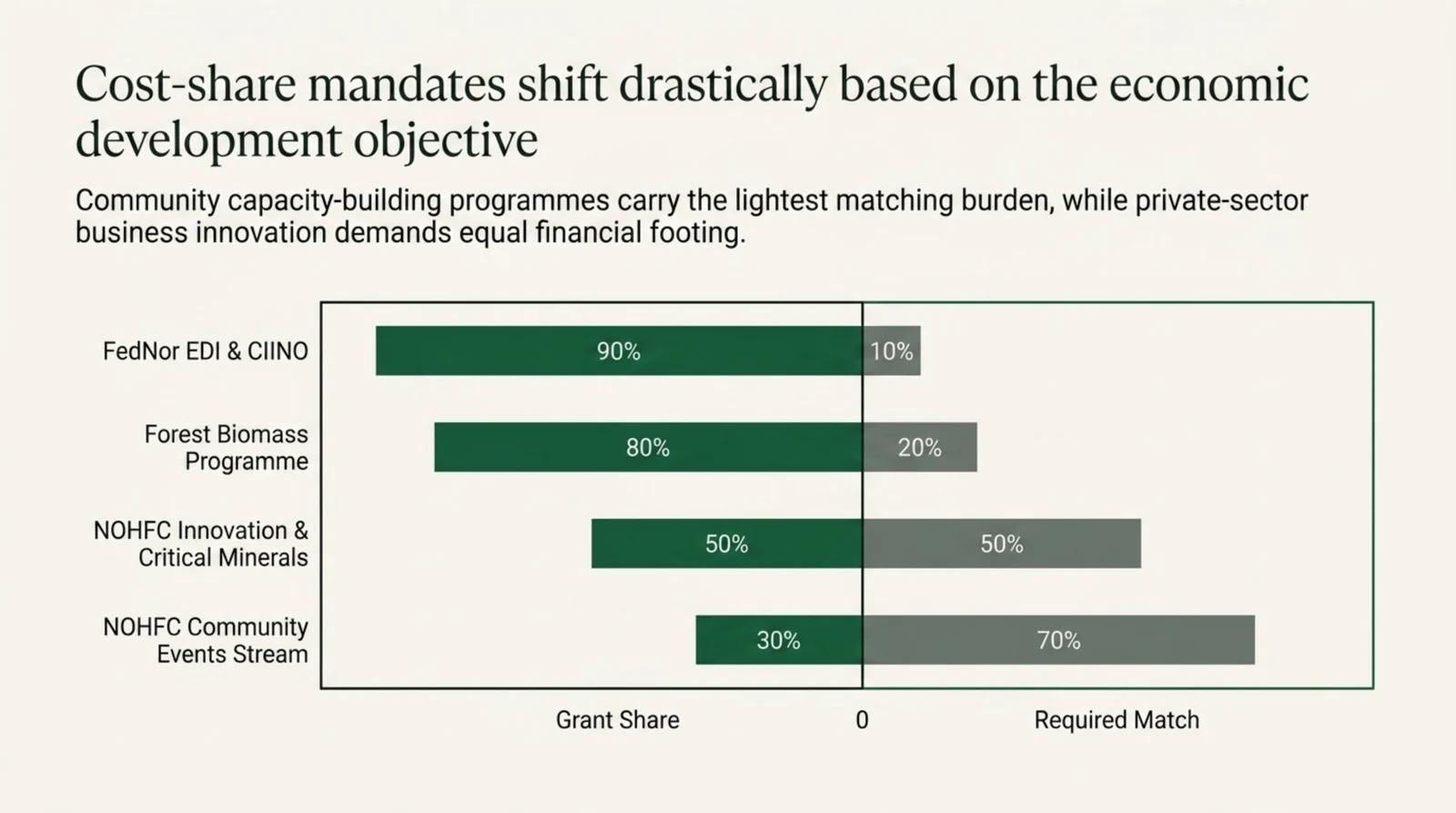
Cost-share levels vary from 10 per cent to more than half of project costs. As a rule, community and Francophone economic development programs carry the lightest match, business innovation programs sit near 50 per cent, and municipal incentive grants pay half of a capped amount. The examples below use each program's published rates; verify before budgeting.
- FedNor's Economic Development Initiative: up to 90 per cent funded, so your minimum contribution is 10 per cent
- CIINO: up to 90 per cent, to $100,000 a year for up to three years, for dedicated economic development capacity
- NOHFC Innovation Stream: up to 50 per cent, capped at $500,000
- NOHFC Community Events Stream: up to 30 per cent, to $15,000, leaving most of the event budget to you and other sources
- Critical Minerals Innovation Fund: up to 50 per cent, to $500,000 per project
- Thunder Bay's core area grants and the Greater Sudbury facade grant: 50 per cent of costs, capped at $10,000 and $20,000 respectively, rising to $30,000 for designated heritage properties in Sudbury
- Community Sport and Recreation Infrastructure Fund: recreation facilities funded at up to 90 per cent of eligible costs in past intakes
- Forest Biomass Program: the Indigenous Bioeconomy Partnerships stream funds up to 80 per cent, to $250,000
Some programs pay 100 per cent of a defined amount instead, such as Thunder Bay's Housing CIP, which pays 100 per cent of eligible costs up to $25,000 per qualifying new unit.
Can one grant count as matching funds for another?
Often, but within limits. Many programs accept other confirmed funding as part of your project financing while capping the total government share of the project, so you usually cannot stack public programs to 100 per cent. Caps vary by program and applicant type, so ask each funder for its stacking limit before you build a multi-funder budget.
- Some funders are explicitly last-in: the Ontario Creates IP Fund makes last-in contributions, meaning the rest of your financing must be confirmed before it commits
- Federal and provincial programs commonly ask you to disclose all other government assistance and may reduce their contribution to stay under a combined cap; verify each program's limit
- Private and philanthropic money, community fundraising and your own cash usually face no stacking limit, which is why a modest non-government contribution often unlocks an otherwise fully stacked budget
What can you do if you cannot fund the match?
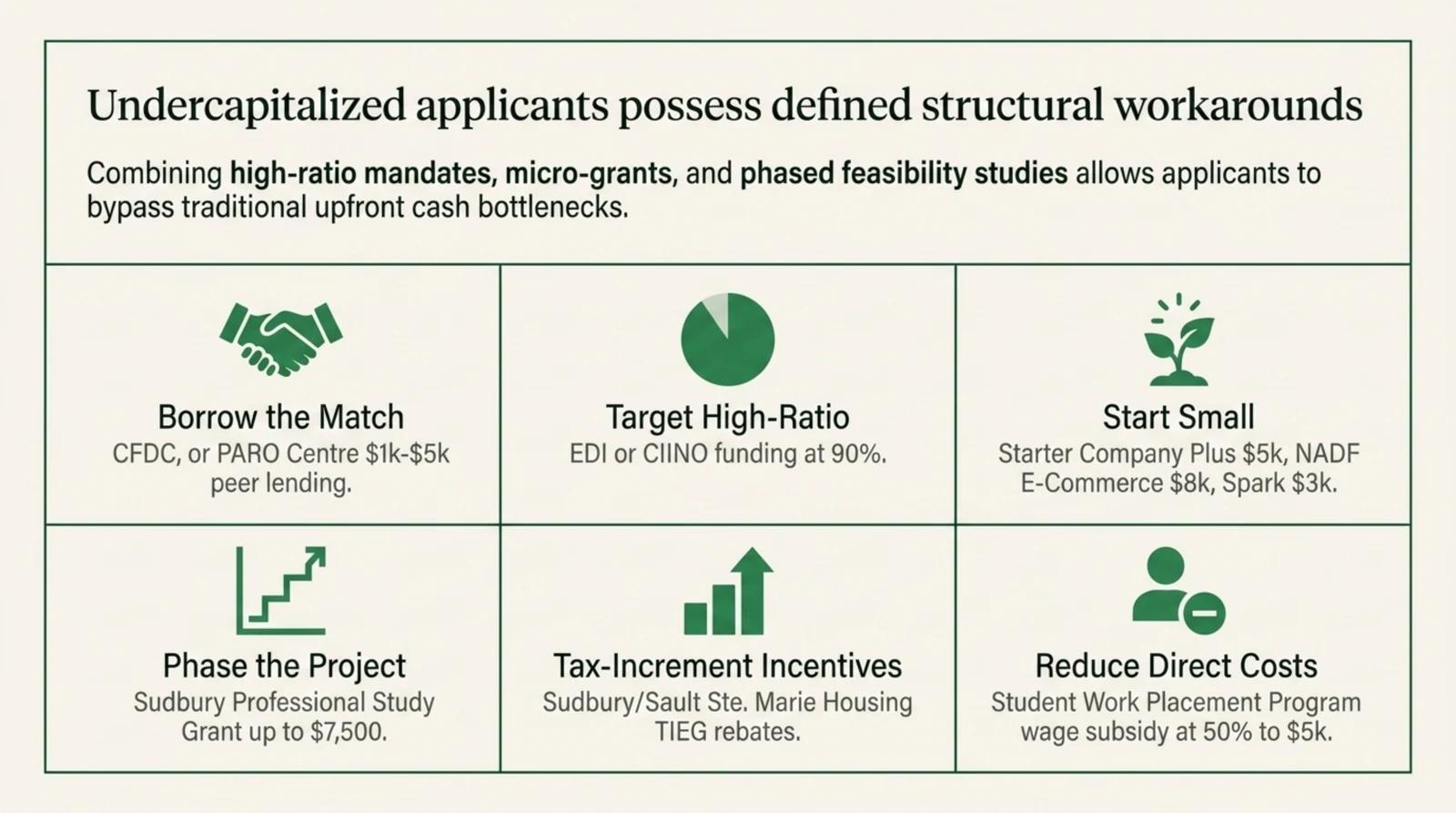
Undercapitalized applicants have real options: borrow the match, pick programs with a high funding share, start with micro-grants that need little or no match, phase the project into affordable stages, or use incentive structures that pay out of future value rather than upfront cash. Many successful first-time applicants combine two or three of these.
- Borrow the match. A CFDC loan or, for women entrepreneurs, a PARO Peer Lending Circle loan of $1,000 to $5,000 can supply the cash side of a grant application
- Choose high-ratio programs. At up to 90 per cent, EDI and CIINO need one dollar from you for every nine funded, where your project fits their mandates
- Start small. Starter Company Plus (a grant of up to $5,000), its Timmins delivery, the NADF E-Commerce Grant (up to $8,000) and Spark (a $3,000 seed grant plus a mentor) build track record without heavy matching
- Phase the project. Fund a feasibility stage first, for example through Greater Sudbury's Professional Study Grant (up to $7,500) or the Sault Foundations Grant for housing feasibility studies, then use the study to raise the capital round
- Use tax-increment incentives. Programs like Greater Sudbury's TIEG and Sault Ste. Marie's Housing TIEG rebate the municipal tax increase your development creates, so the benefit arrives as annual grants after completion with no separate match to raise
- Reduce costs instead of raising match. Wage subsidies such as the Student Work Placement Program, reported at 50 per cent of wages to $5,000 per placement, cut project labour costs directly
How do you document matching and in-kind contributions?
Document every contribution the way an auditor would want to see it: bank statements and loan letters at application, invoices and proof of payment during the project, and signed timesheets or donation letters for in-kind items. Programs pay claims against evidence, and weak documentation is one of the most common reasons payments are delayed or reduced.
- At application: bank confirmation of cash, financing approval letters, commitment letters from other funders, and written valuations for any in-kind items
- During the project: keep invoices, receipts and proof of payment for every claimed cost, and track in-kind hours contemporaneously rather than reconstructing them afterward
- At claim time: most contribution programs reimburse against documented paid costs, so plan cash flow to carry expenses until claims are paid
- Do not count on costs incurred before approval; they are commonly ineligible unless the program states otherwise in writing