What counts as Northern Ontario for grant purposes?
Updated Oct 1, 2026 · program facts link to dataset records
What counts as Northern Ontario?
For most grant programs, Northern Ontario means eleven territorial districts: Algoma, Cochrane, Kenora, Manitoulin, Muskoka, Nipissing, Parry Sound, Rainy River, Sudbury (including the City of Greater Sudbury), Thunder Bay and Timiskaming. Muskoka is the newest addition, reported as joining the provincial definition in about 2025. FedNor's federal service area has included Muskoka for years (12 census divisions), while the Northern Health Travel Grant still uses a ten-district health boundary that leaves Muskoka out.
There is no single legal definition of Northern Ontario that every funder uses. Each program sets its own boundary, and three versions matter most for grants:
- The provincial (NOHFC) definition, which restored Muskoka in January 2025
- The federal (FedNor) definition, 12 census divisions including Muskoka
- Program-specific definitions, such as the ten districts used by the Northern Health Travel Grant
The rest of this guide sets out each boundary, what changed with Muskoka, and how to confirm your address qualifies before you spend time on an application.
Which districts does NOHFC count as Northern Ontario?
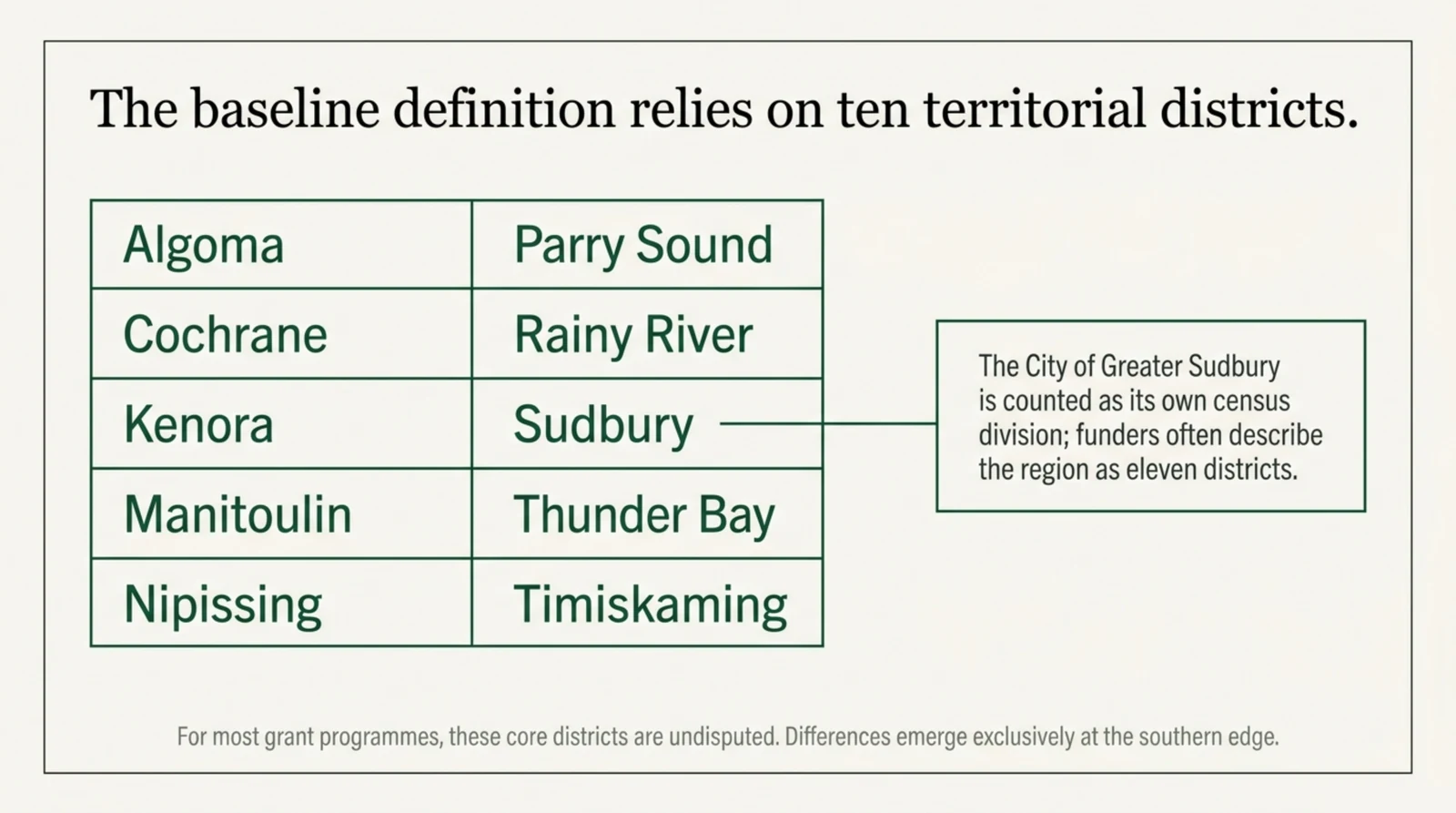
The Northern Ontario Heritage Fund Corporation (NOHFC), the province's main development funder for the region, treats Northern Ontario as the territorial districts of Algoma, Cochrane, Kenora, Manitoulin, Nipissing, Parry Sound, Rainy River, Sudbury, Thunder Bay and Timiskaming, plus, reportedly since about 2025, the District of Muskoka. If your business, municipality or organization is based in one of these districts, NOHFC programs are open to you.
That single boundary controls access to a wide range of programs, including:
- INVEST North business expansion funding for existing Northern Ontario businesses
- the Locate stream, worth up to $5 million for businesses establishing new operations in the region
- the Innovation Stream, covering up to 50 per cent of eligible costs to a maximum of $500,000
- workforce development internships and community infrastructure funding
- Rural programs such as the Rural Enhancement stream and the Regional Tile Drainage Program
Note the distinction between the District of Sudbury and the City of Greater Sudbury. Both sit inside NOHFC's boundary, but some streams treat larger urban centres differently from rural communities, so read each stream's rules rather than assuming the districts are treated uniformly.
Is Muskoka part of Northern Ontario?
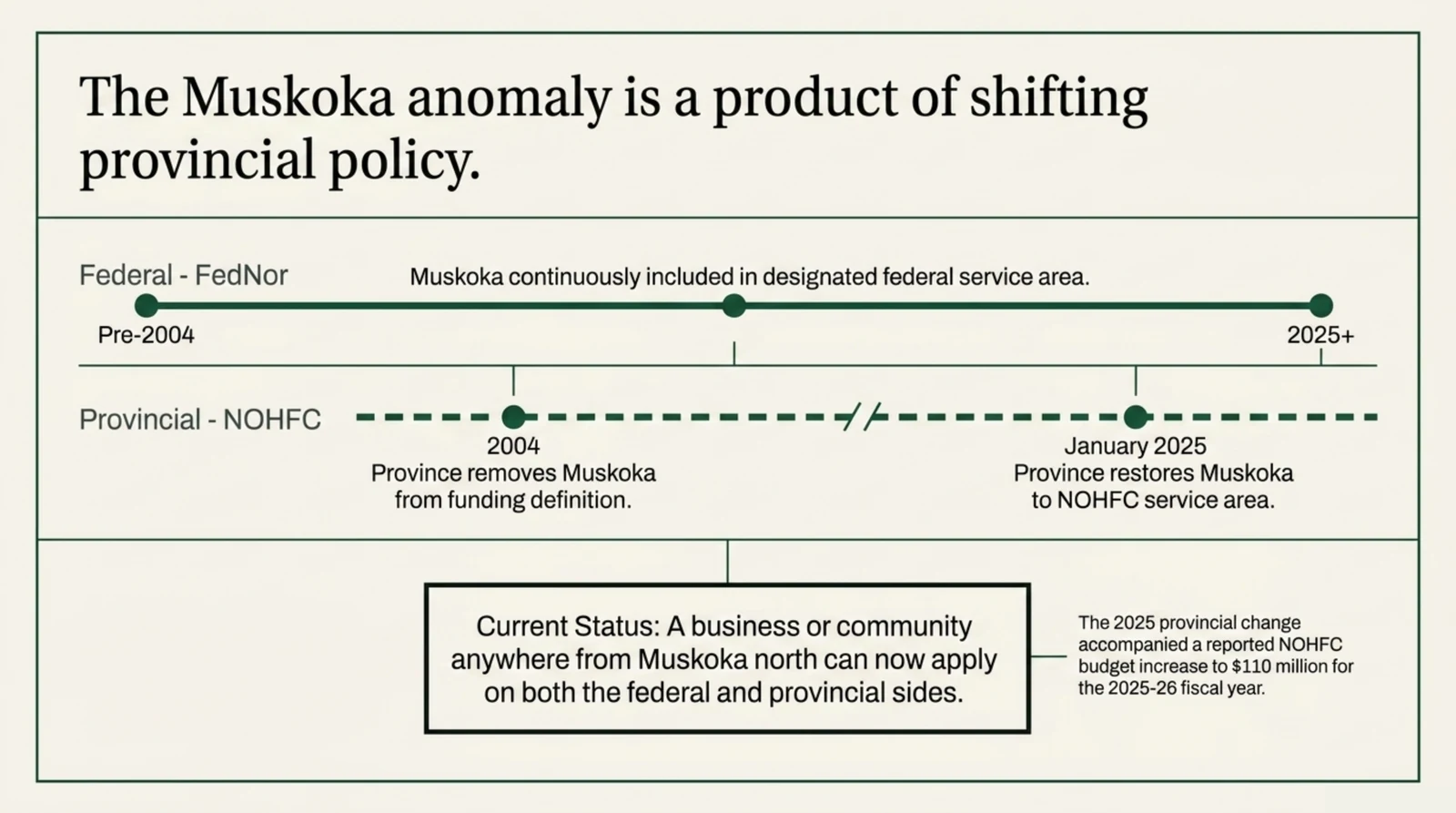
For provincial funding purposes, Muskoka is now reported to be part of Northern Ontario. Ontario moved to include the District of Muskoka in NOHFC's catchment area, with eligibility reported as taking effect around 2025. For the Northern Health Travel Grant, Muskoka remains outside the eligible area; for FedNor it has been eligible since 2019. If you are in Muskoka, verify your eligibility with each funder directly before applying.
The practical effect, as reported:
- Muskoka businesses and communities can apply to NOHFC programs such as INVEST North: Launch and the Community Events Stream, subject to each stream's own rules
- Muskoka is not listed in FedNor's service area, so programs such as the Northern Ontario Development Program do not apply there
- Muskoka is not among the ten districts eligible for the Northern Health Travel Grant
Because the change is recent and program guidelines update at different speeds, treat Muskoka eligibility as something to confirm in writing with the program officer, not something to assume from a map.
What area does FedNor cover?
FedNor, the federal economic development agency for Northern Ontario, serves the ten territorial districts of Algoma, Cochrane, Kenora, Manitoulin, Nipissing, Parry Sound, Rainy River, Sudbury, Thunder Bay and Timiskaming. Muskoka has been part of FedNor’s service area since 2019, when it moved over from the southern Ontario agency; verify with FedNor if you are near the boundary. Inside the ten districts, both federal and provincial northern programs are open to you.
FedNor's boundary governs programs including:
- the Northern Ontario Development Program (NODP), FedNor's core business and community funding
- the Tourism Growth Program and Youth Internships
- the Economic Development Initiative for Francophone economic development, which covers up to 90 per cent of project costs
- the Community Futures Program, which core-funds 24 Community Futures Development Corporations (CFDCs) across rural Northern Ontario; your local CFDC also delivers business loans directly
Within the federal boundary, delivery is often local. Each CFDC serves a defined rural catchment, so two neighbouring communities may deal with different offices. FedNor can confirm which CFDC covers your address.
Which districts qualify for the Northern Health Travel Grant?
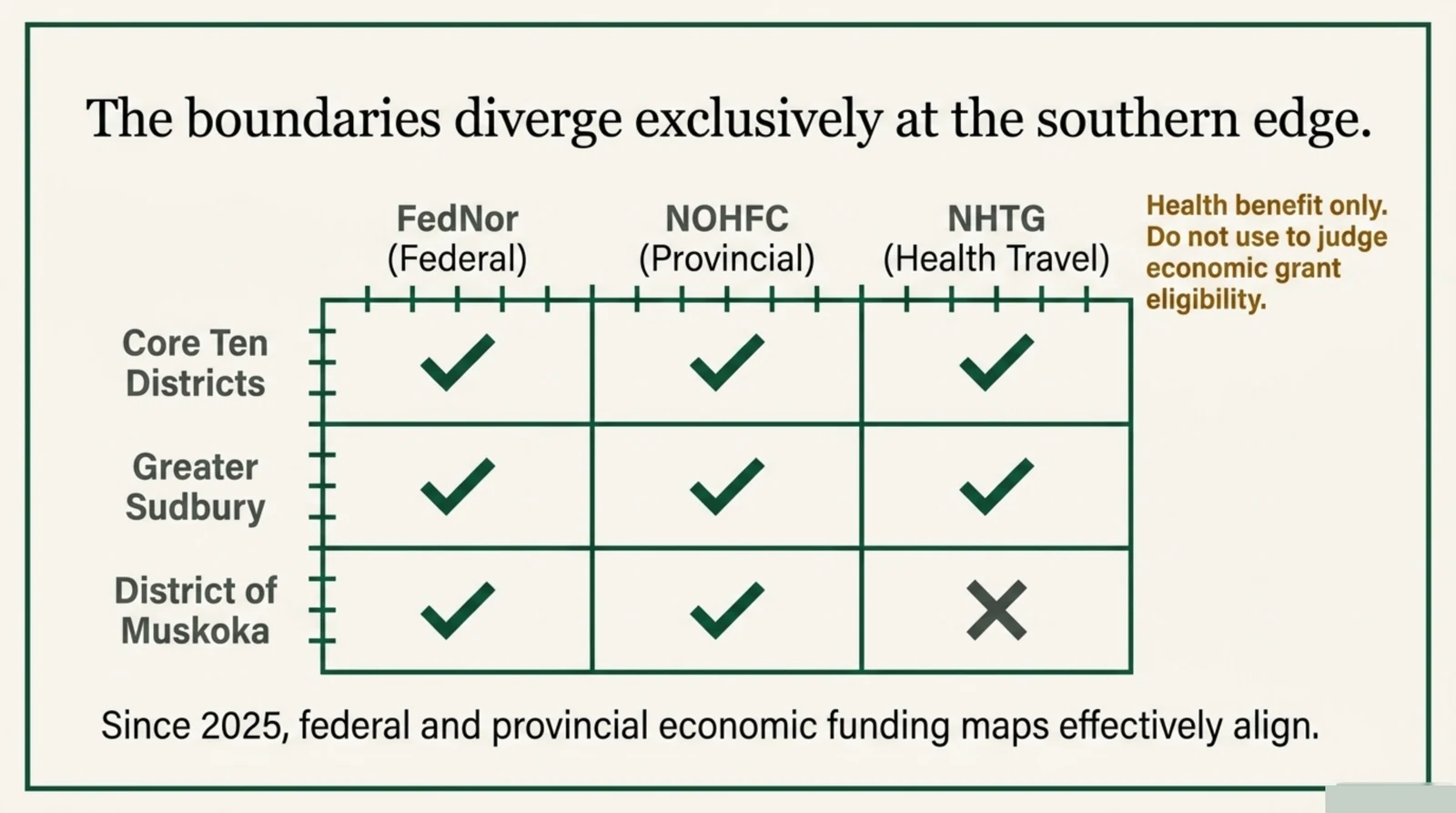
The Northern Health Travel Grant uses its own list of ten eligible districts: Algoma, Cochrane, Kenora, Manitoulin, Nipissing, Parry Sound, Rainy River, Sudbury, Thunder Bay and Timiskaming. If you live in one of them and must travel 100 kilometres or more one way to the nearest specialist or ministry-funded health facility, the grant pays 41 cents per kilometre toward the trip.
Points worth knowing:
- A deductible is commonly reported to apply to each trip's mileage; verify the current rules with the ministry before budgeting
- Muskoka is not among the ten eligible districts as of August 2026
- The separate Ontario Indigenous Travel Grant historically covered travel between remote First Nations communities and postsecondary institutions at a reported $1,300 per one-way trip; confirm its current status before relying on it
Which programs draw their own northern boundaries?
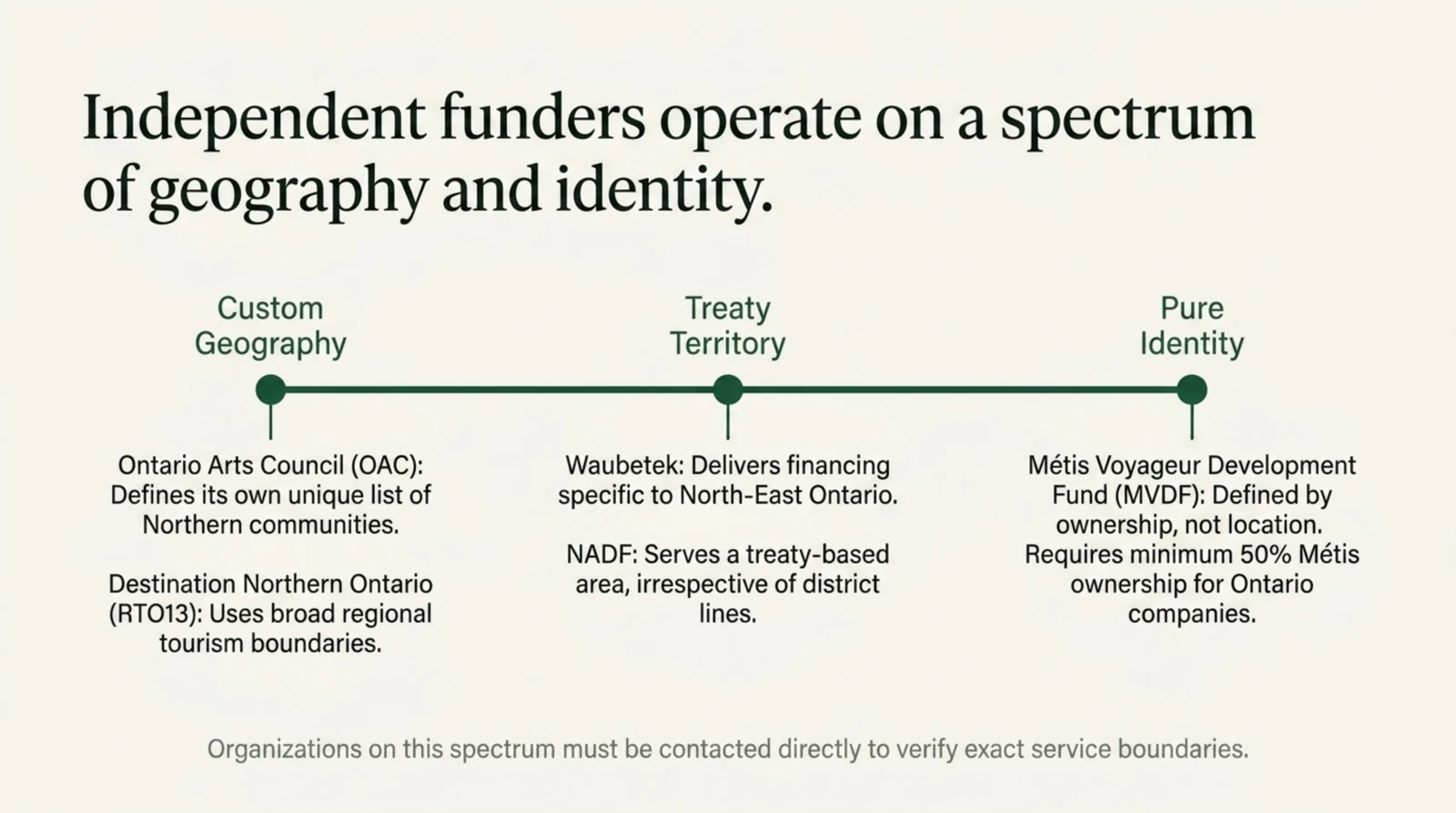
Beyond the three main definitions, many funders draw their own lines. Arts funders, Indigenous financial institutions, student aid and municipal incentive programs each use a different map. The pattern to remember: the bigger the funder, the more likely it uses the standard district list; the more local or specialized the program, the more likely the boundary is custom.
- Arts: the Ontario Arts Council's Northern Arts Projects program uses a northern definition that includes the Manitoulin, Parry Sound and Nipissing districts alongside the rest of the North, with grants of up to $15,000 per category
- Indigenous business funders: NADF serves a defined Northern Ontario service area (check its map), Waubetek delivers equivalent financing in north-eastern Ontario, and the Métis Voyageur Development Fund lends anywhere in Ontario where a Métis owner holds at least 50 per cent of the business
- Students: OSAP's Distance Grants ignore districts entirely; the test is a permanent home 80 kilometres or more from the closest college or university of the type you attend
- Municipal incentives: community improvement plan grants in Thunder Bay, Greater Sudbury, Sault Ste. Marie, North Bay and Timmins apply only within each city, and often only within designated project areas inside it
- Tourism: Destination Northern Ontario operates as Regional Tourism Organization 13, covering the North as a whole
How do you confirm your address qualifies?
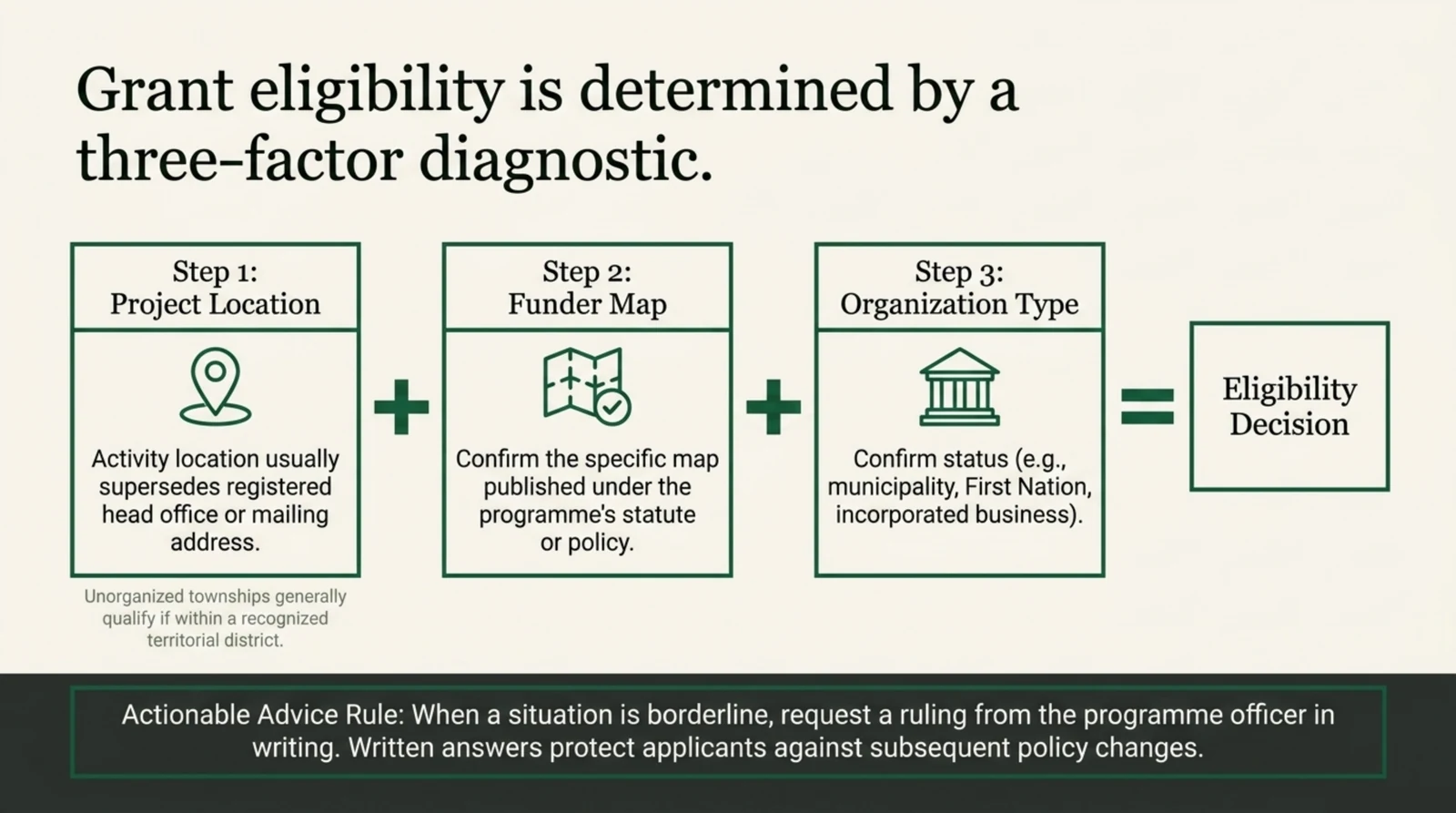
Check the program's own eligibility page or map, then confirm with a program officer in writing if anything is unclear. District names, not travel time or postal codes, decide most northern eligibility, and unorganized townships count because they sit inside districts. Five minutes of confirmation can save weeks of work on an ineligible application.
- Identify your territorial district; your municipality's website or property tax bill will name it
- Match it against the program's published list, not a general sense of what feels northern
- Watch for programs with sub-boundaries: municipal CIP project areas, CFDC catchments, and Indigenous funders' service areas
- If you are in Muskoka or a border community in the Parry Sound or Nipissing districts, ask the funder to confirm eligibility in writing before you invest in an application