What replaced the Tourism Growth Program in Northern Ontario?
Updated Oct 2, 2026 · program facts link to dataset records
Is the Tourism Growth Program still open?
No. The Tourism Growth Program was a time-limited federal initiative delivered in Northern Ontario by FedNor, and its intake is reported closed, with the multi-year funding window wound down. As of August 2026 no direct federal successor has been announced. Verify the current status on FedNor's site before ruling it out entirely, since program pages sometimes outlive the intakes they describe.
Two immediate consequences. If you hold an active TGP contribution agreement, it continues on its own terms; direct questions about claims and milestones to your FedNor officer rather than assuming anything from the program's public status. If you were planning an application, the money you were counting on now has to come from the mix of provincial, regional, and local programs below, and the right mix depends on what kind of project you have: capital expansion, a new product, an event, or a capability gap.
What can established tourism businesses apply for now?
The main successors for expansion projects are NOHFC and FedNor's core programming. NOHFC's Grow stream supports existing Northern Ontario businesses expanding their operations, tourism operators included; support is cost-shared, and current rates and caps should be confirmed on NOHFC's site before you build a budget around them. FedNor's Northern Ontario Development Program remains FedNor's standing fund for business and community economic development, and tourism projects were eligible there before TGP existed; check current priorities and intake status with a FedNor officer.
For debt financing, the region's Community Futures Development Corporations lend commonly up to $150,000 to rural businesses, and tourism operators are among their core clients. A CFDC loan can also supply the matching share a NOHFC application requires, which is often the binding constraint now that TGP's non-repayable federal money is gone.
What if you are launching a new tourism business or product?
Start with Spark: winners receive a $3,000 seed grant plus a matched tourism-industry mentor to launch a new tourism idea in Northern Ontario, delivered by the Tourism Innovation Lab with Destination Northern Ontario. It is small money but real, aimed exactly at the new-idea stage, and the mentor is often worth more than the cheque. Intakes are periodic rather than continuous, so watch for the current round.
For a new business rather than a new product, NOHFC's Launch stream covers new and early-stage Northern Ontario businesses on cost-shared terms; confirm current eligibility and rates with NOHFC. General start-up supports also apply to tourism: Starter Company Plus pairs business training with a grant of up to $5,000 for adults starting, expanding, or buying a business, and a seasonal tourism operation qualifies like any other business.
What about festivals and events?
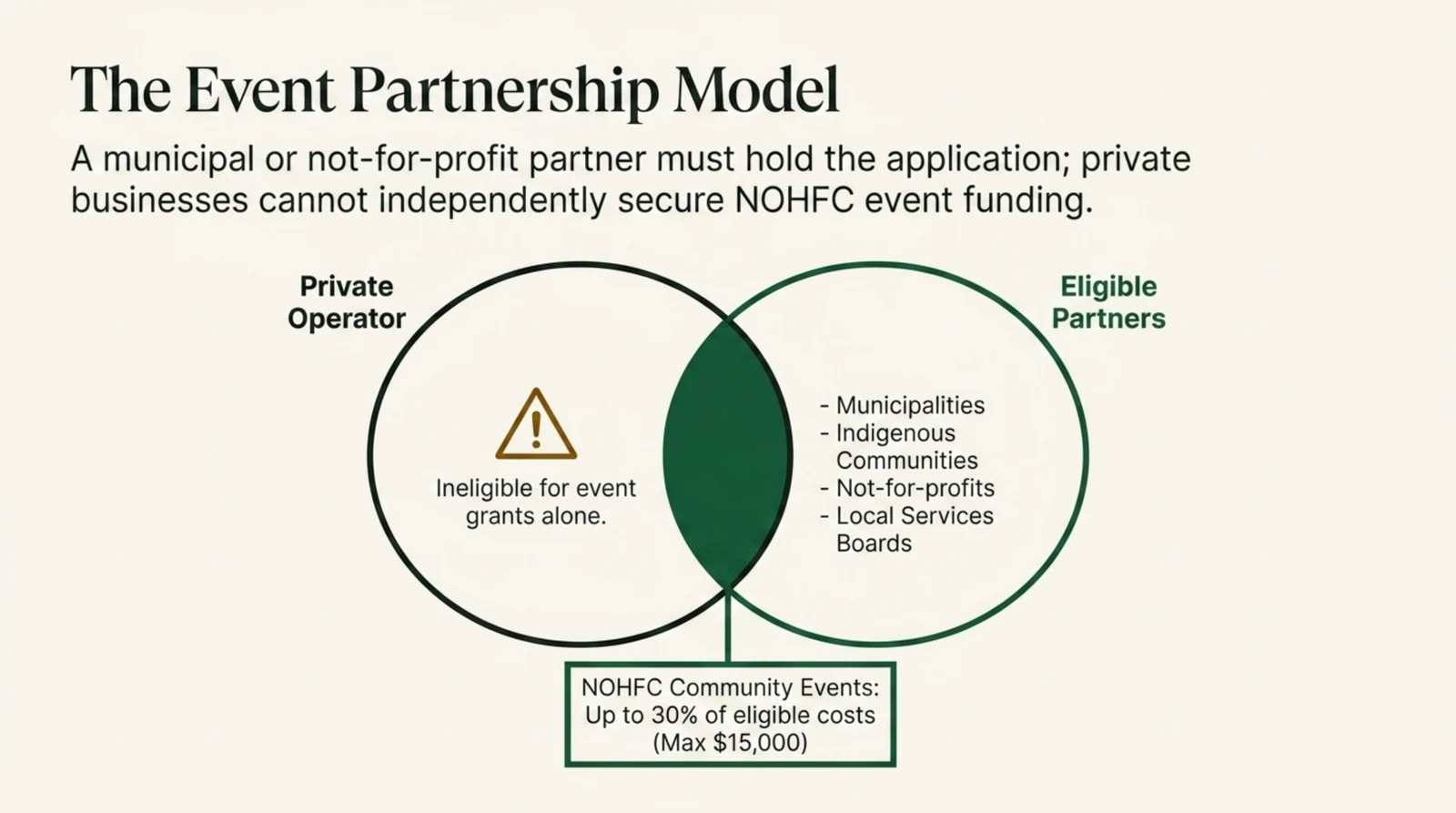
The standing fund is NOHFC's Community Events Stream, which gives municipalities, Indigenous communities, not-for-profits, and Local Services Boards up to 30 per cent of eligible costs to a maximum of $15,000 per event. Note who is on that list: private businesses are not, so an operator-run event generally needs a municipal or not-for-profit partner to hold the application.
Event organizers should also raise their project with Destination Northern Ontario, since event-related product development and promotion can fit its partnership model described below. Municipalities are worth asking too: several Northern Ontario cities run their own event and tourism supports outside the regional programs covered here, and a local contribution strengthens a NOHFC application in any case.
Where do Destination Northern Ontario and Tourism Excellence North fit?
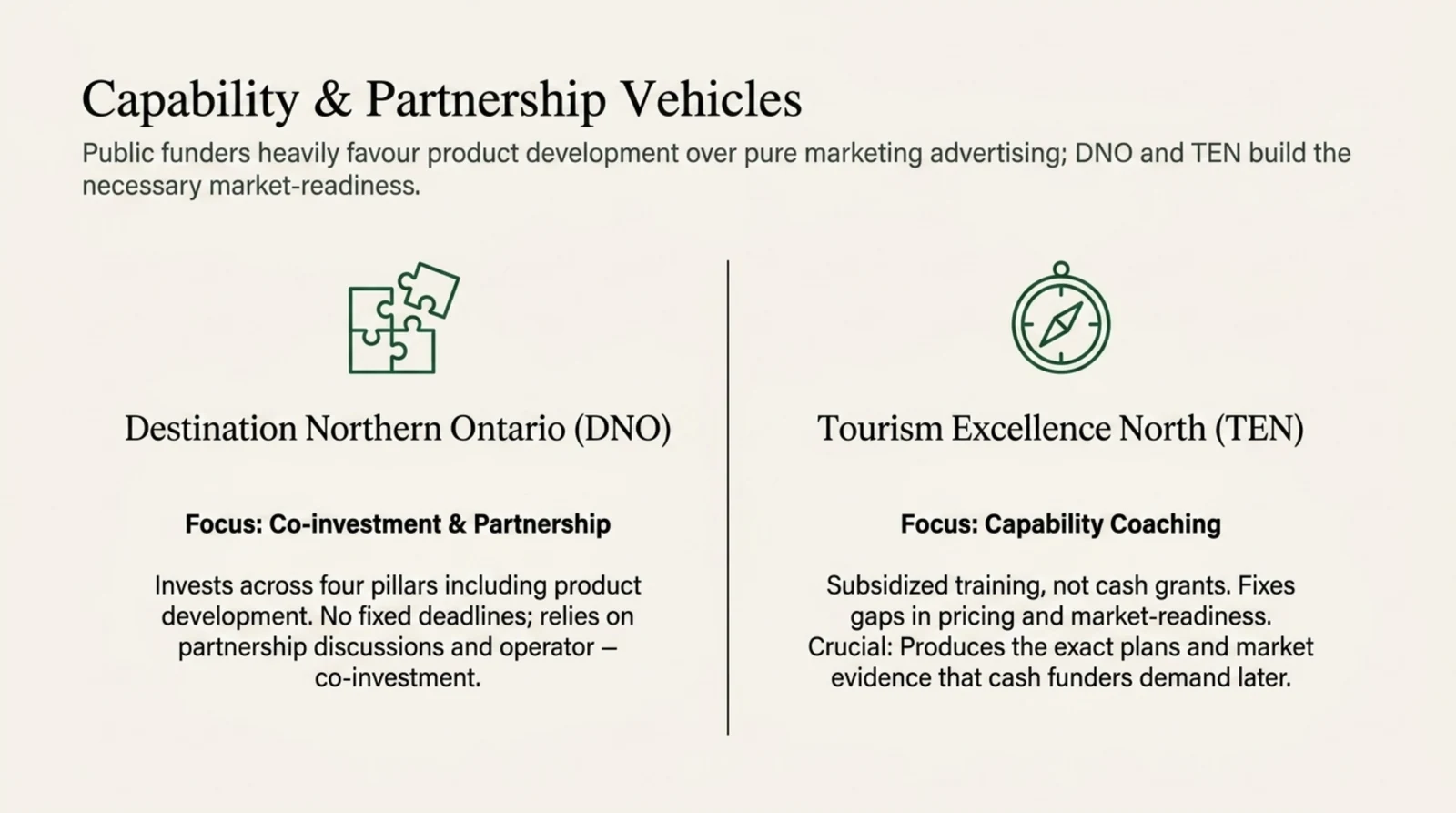
Destination Northern Ontario's partnership initiatives are the region's co-investment channel: DNO partners with tourism businesses, destination marketing organizations, municipalities, and sector organizations on initiatives across four pillars, including product development. This is not a form-and-deadline grant program; it works through partnership discussions, so the route in is contacting DNO with a project that fits its current strategy and being ready to co-invest.
Tourism Excellence North is DNO's training arm: subsidized coaching and learning for Northern Ontario operators, communities, and destinations rather than cash grants. After TGP, that distinction matters. If your gap is capability, such as pricing, packaging, or market-readiness, rather than capital, TEN is the program that actually addresses it, and completing it strengthens later funding applications elsewhere because it produces exactly the plans and market evidence funders ask for.
How should you build a tourism funding stack now?
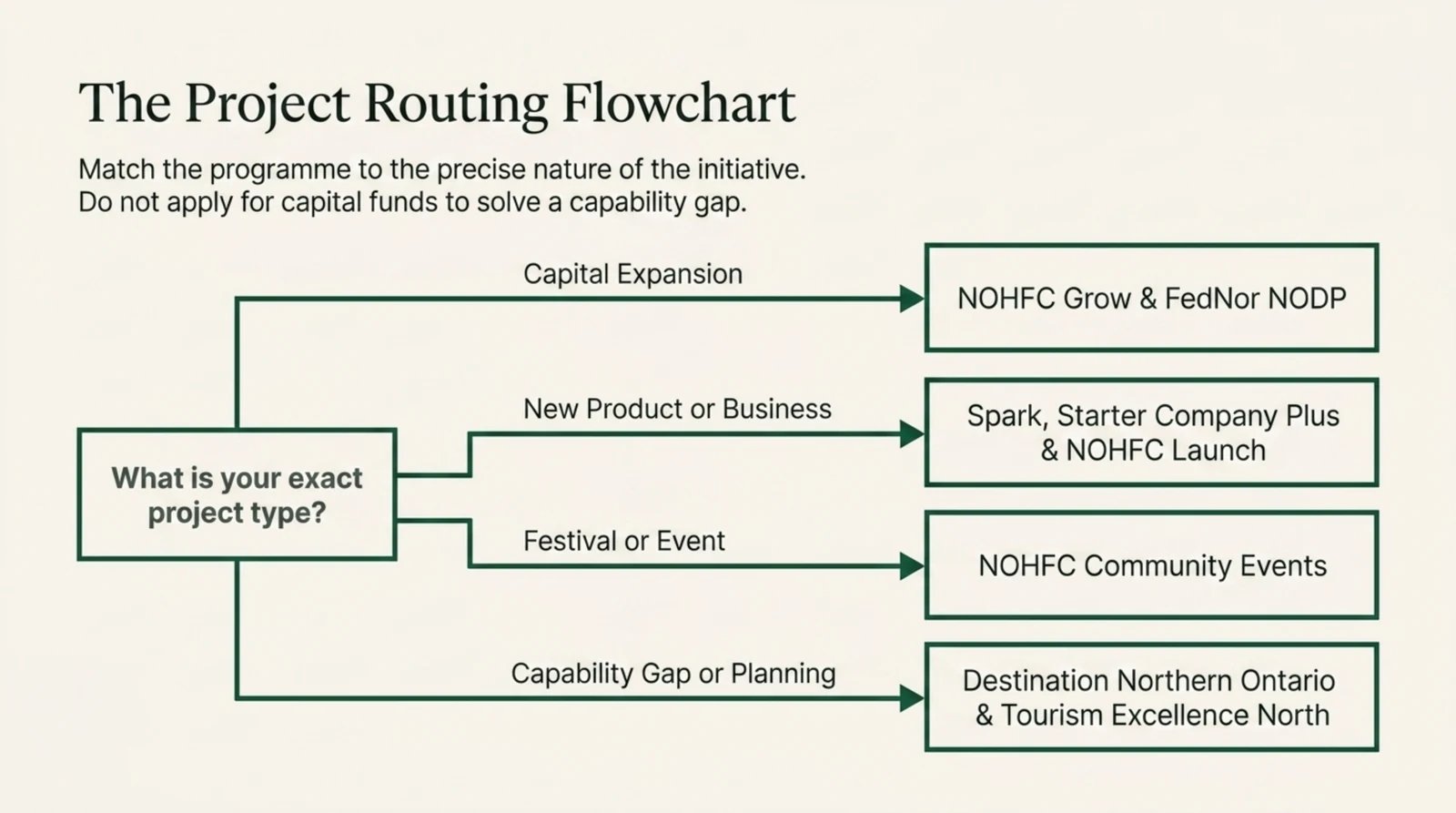
Match the program to the project type, and open the regional conversations early. A workable sequence for most operators:
- Classify your project: capital expansion, new product or business, event, or capability gap. Each maps to a different lead program above.
- Talk to your CFDC and to DNO before writing anything. Both know what is currently funding in your subregion, and both conversations are free.
- Line up your matching share first. Post-TGP, most remaining programs are cost-shared, so the constraint is usually your contribution, not the application itself.
- Apply to the lead program, then layer smaller supports such as Spark or Community Events money around it where program rules allow.
The honest summary: the federal tourism-specific money is gone for now, NOHFC carries the capital load, DNO carries partnership and capability, and loans bridge the rest. Operators who accept that mix early move faster than those waiting for a TGP successor that has not been announced.