NOHFC or FedNor: which funder fits your project?
Updated Oct 1, 2026 · program facts link to dataset records
What is the difference between NOHFC and FedNor?
NOHFC (the Northern Ontario Heritage Fund Corporation) is a provincial agency funded by the Government of Ontario. FedNor is the Government of Canada's regional economic development agency for Northern Ontario. Both fund businesses, municipalities, Indigenous communities and not-for-profits across the region, but they answer to different governments, favour different funding instruments, and run different application processes.
The practical consequence: they are not interchangeable, and they are not competitors. Many Northern Ontario projects draw on both. Which one you approach first depends on what you are (a business, a municipality, a not-for-profit), what the money is for, and whether your project can carry repayable financing.
Do NOHFC and FedNor cover the same area?
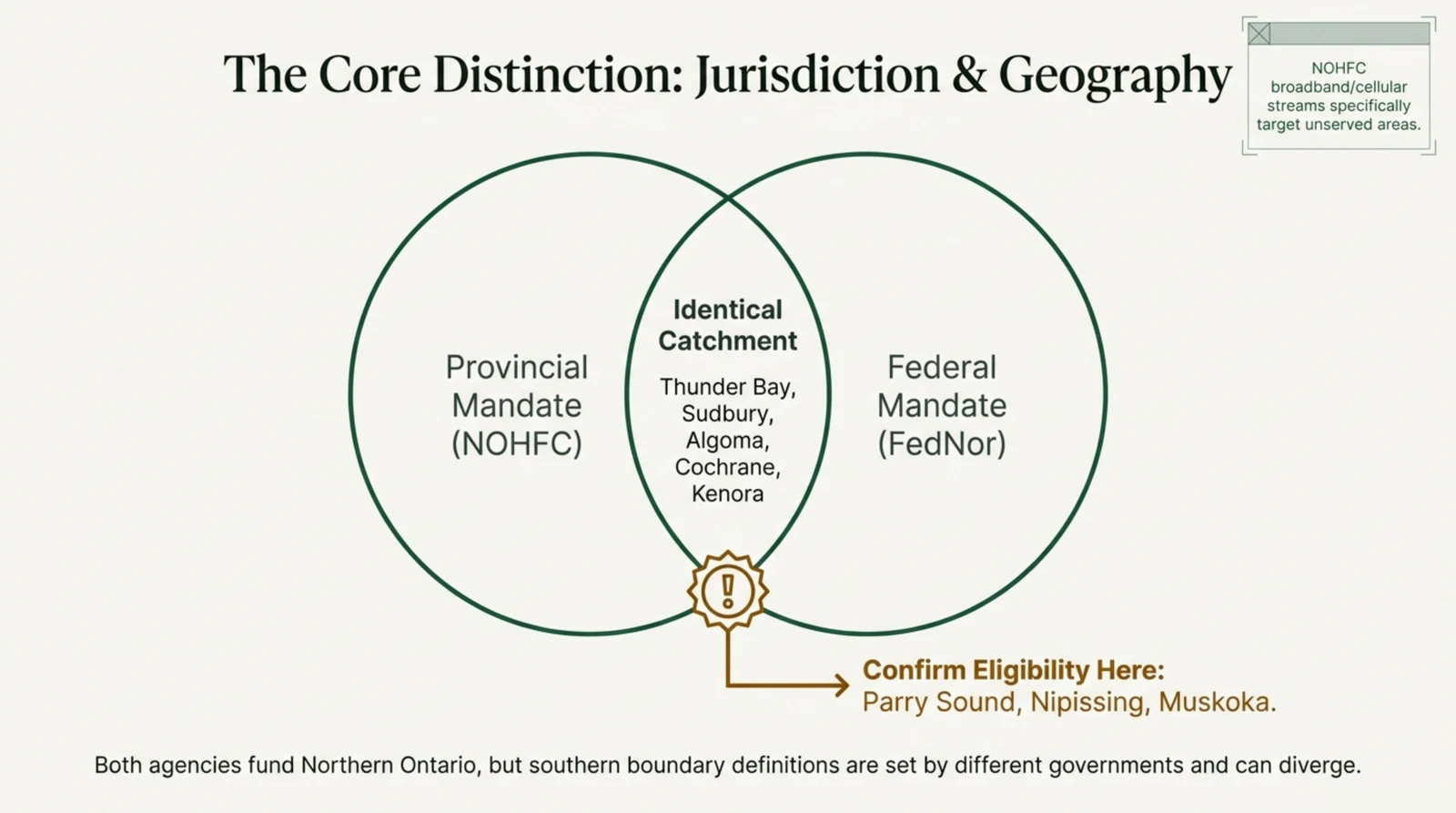
Largely, yes. Both fund projects across Northern Ontario, and for most applicants in districts such as Thunder Bay, Sudbury, Algoma, Cochrane or Kenora the two maps are identical in practice. NOHFC uses Ontario's definition of Northern Ontario, generally the territorial districts of the region including Nipissing, Parry Sound and Manitoulin. FedNor's catchment is defined federally and overlaps almost completely.
The edges are where it matters. If you are near the southern boundary of the region, in or around Parry Sound, Nipissing or Muskoka, confirm your eligibility with each funder directly before investing time in an application, because the two definitions are set by different governments and can diverge there. Program-specific geography also exists within each funder: for example, NOHFC's broadband and cellular stream targets unserved and underserved areas specifically.
What funding instruments does each use?
NOHFC funds mostly through conditional contributions: money you do not repay as long as you meet the conditions in your agreement. On larger business projects it sometimes pairs the contribution with a repayable term loan. FedNor also funds through contribution agreements, but its support to for-profit businesses is commonly structured as repayable contributions, while support to not-for-profits and communities is commonly non-repayable. Verify the instrument for your specific program before building a budget.
On the NOHFC side, the main doors for business are the INVEST North streams: Launch for newer businesses, Grow for expansions, Locate for businesses establishing new operations in the North (up to $5 million as a conditional contribution, sometimes paired with a term loan), and the Innovation Stream (up to 50% of eligible costs, with a reported cap of $500,000). Community applicants use Enhance Your Community and the Rural Enhancement stream. Employers use the Workforce Development and Indigenous Workforce Development streams, and producers use the Film and Television stream.
On the FedNor side, the core program is the Northern Ontario Development Program (NODP), with targeted initiatives around it: Tourism Growth, Youth Internships for eligible organizations hiring interns, the Economic Development Initiative for Francophone economic development (up to 90% of project costs), and CIINO, which pays up to 90% of costs to a maximum of $100,000 a year for up to three years so small communities can staff dedicated economic development capacity. FedNor also core-funds the region's 24 Community Futures Development Corporations through the Community Futures Program; your local CFDC is the front door for small business loans, commonly up to $150,000.
How do the timelines compare?
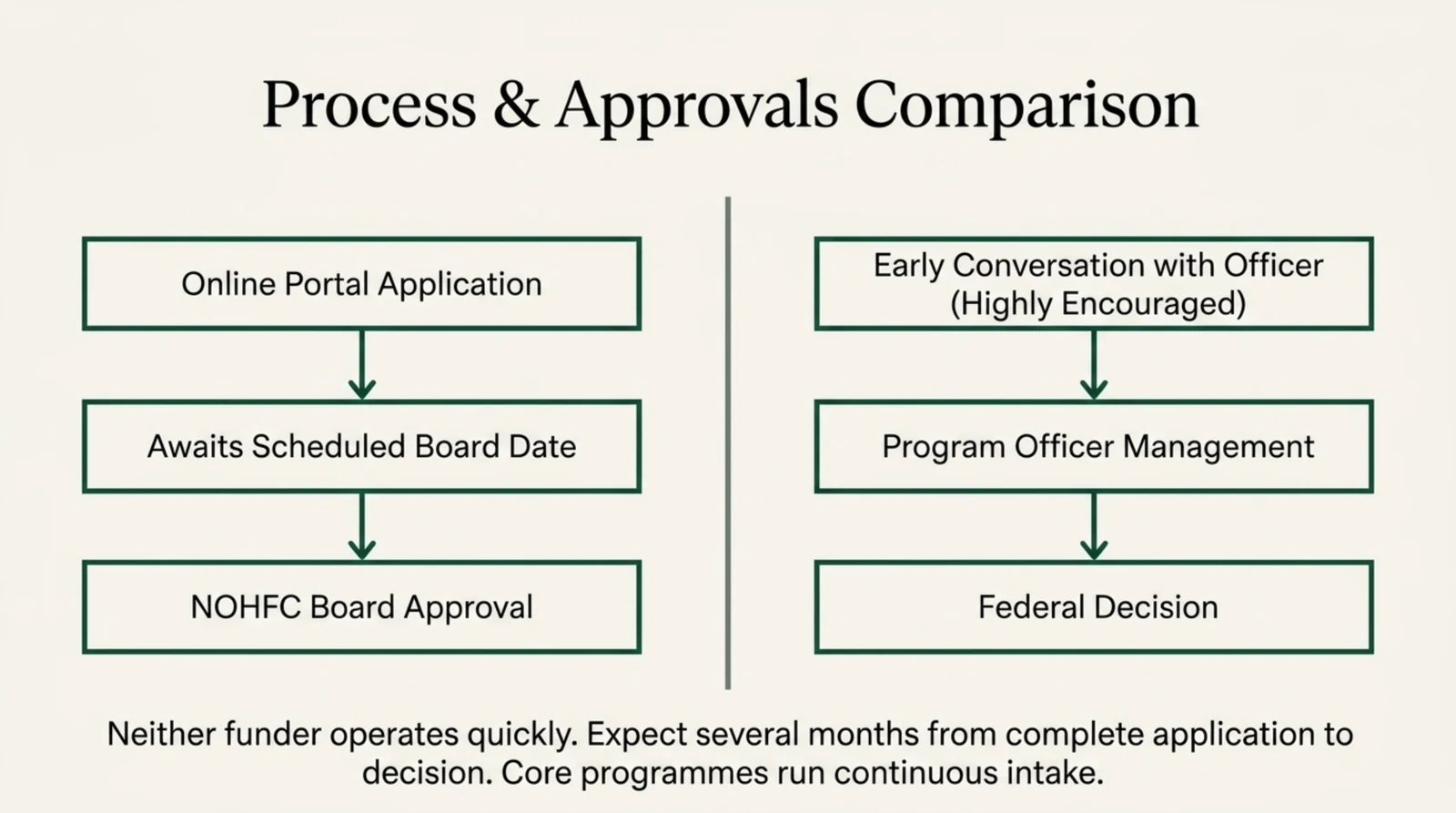
Neither funder is fast, and neither publishes a guaranteed decision time. Both run continuous intake for their core programs rather than fixed annual deadlines, though individual streams can have intake windows. Applicants commonly report several months from a complete application to a decision at both agencies, and large or complex projects take longer. Verify current expectations with the officer handling your file.
Process differs more than speed. NOHFC applications go through its online portal, and approvals are made by the NOHFC board, which meets periodically, so your file waits for a board date. FedNor files are managed by program officers, and FedNor encourages contact with an officer before you apply; that early conversation shapes the application and is worth having.
One rule binds at both agencies: costs incurred before approval are generally ineligible, and starting work early can disqualify a project entirely. Do not sign contracts or start construction on the assumption that an approval is coming.
When does each funder fit best?
Approach NOHFC first when you want non-repayable support tied to jobs and investment in the North. Approach FedNor first when your project suits repayable financing, is led by a not-for-profit or community organization, or fits one of its targeted initiatives. In practice, most serious projects should have an early conversation with both.
NOHFC tends to fit:
- Businesses starting up, expanding or locating in the North: Launch, Grow and Locate.
- Hiring and training support: the Workforce Development stream.
- Municipal and community capital projects: Enhance Your Community, Rural Enhancement, and the Community Events stream (up to 30% of eligible costs to a maximum of $15,000).
- Film and television production: the Film and Television stream.
- Agriculture: the Regional Tile Drainage Program covers 50% of tile drainage contractor costs to a maximum of $500 per acre.
FedNor tends to fit:
- Business projects that can carry repayable financing under the NODP, or a first loan through your local CFDC (Community Futures business loans).
- Francophone organizations: EDI, at up to 90% of project costs.
- Small municipalities, Indigenous communities and CFDCs building economic development capacity: CIINO.
- Tourism operators and destinations: Tourism Growth.
- Organizations hiring interns: Youth Internships.
For innovation projects, compare NOHFC's Innovation Stream with federal support through NRC IRAP, which combines advisory services with project funding for technology firms.
Can you use both on one project?
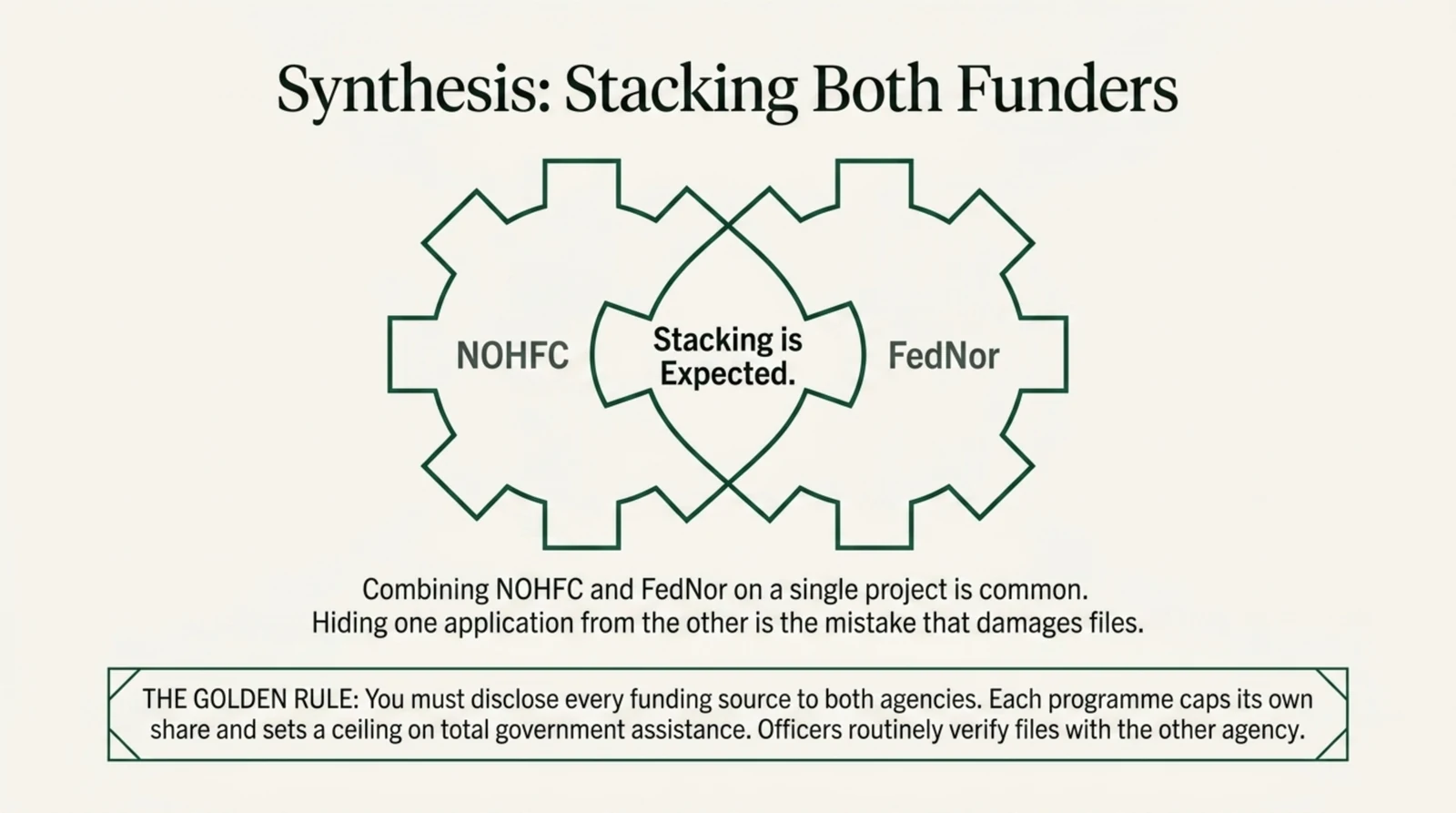
Yes. Combining NOHFC and FedNor on a single project is common, and both funders expect it. Each program caps its own share and your total government assistance, and you must disclose every funding source in every application. The mechanics, the maximum government share, and the timing risks of stacked approvals are covered in our guide to stacking NOHFC and FedNor funding.