How does the NOHFC application process work?
Updated Oct 1, 2026 · program facts link to dataset records
What are the stages of an NOHFC application?
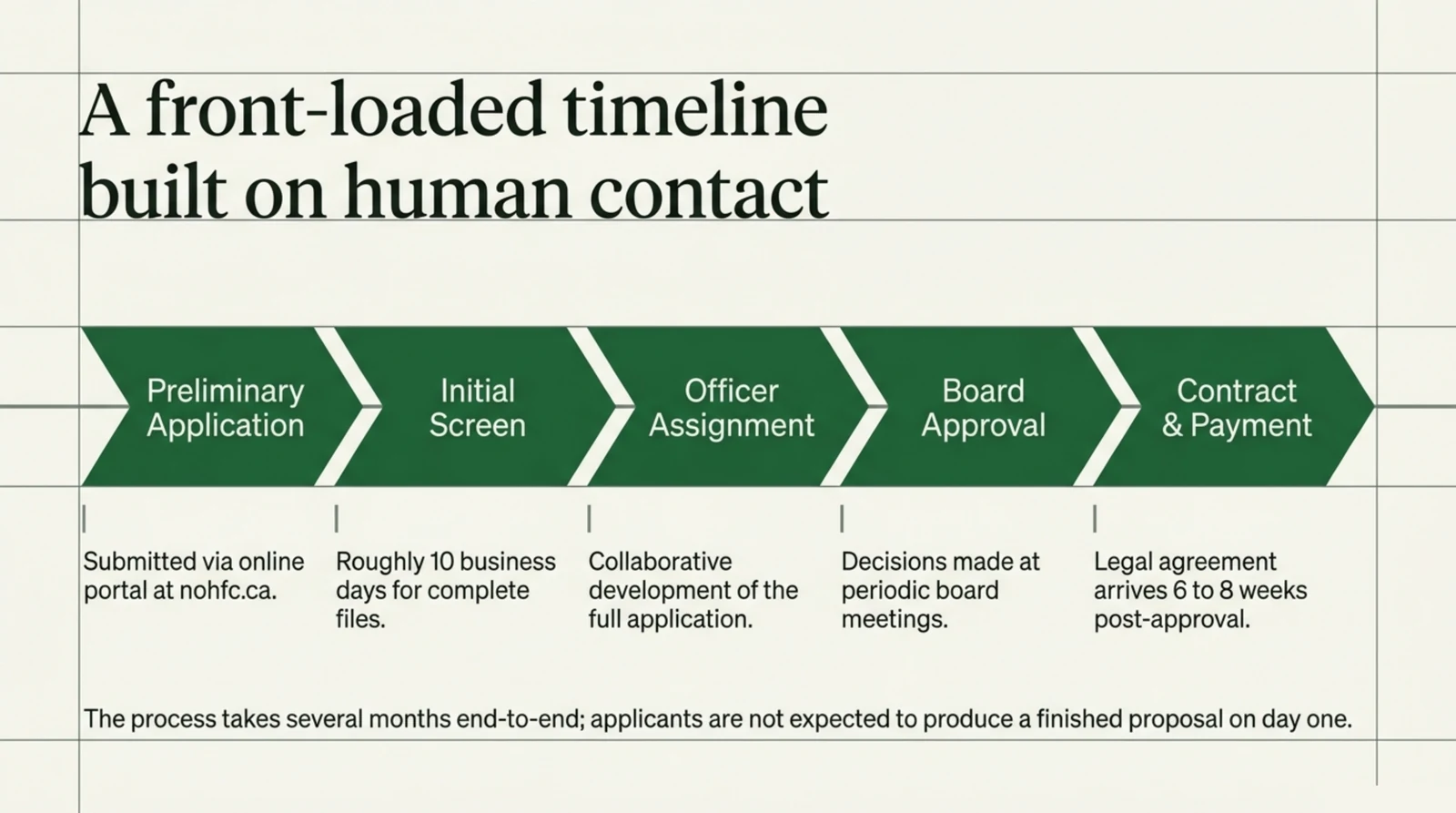
NOHFC applications move through five stages: a short preliminary application submitted online, an initial screen reported to take about 10 business days, a working relationship with an assigned program officer, a full proposal that commonly runs 8 to 10 pages plus attachments, and a decision by the NOHFC board followed by a funding contract, reported to arrive 6 to 8 weeks after approval.
The Northern Ontario Heritage Fund Corporation (NOHFC) is a provincial agency, and its funding streams share broadly the same two-part structure: a light preliminary application first, then an invited full application developed with staff support. The process is deliberately front-loaded with human contact. You are not expected to produce a finished proposal on day one, and applicants who try usually end up rewriting it once an officer is assigned.
- Preliminary application through the online portal at nohfc.ca.
- Initial screen, reported at roughly 10 business days for a complete submission.
- Officer assignment and development of the full application together.
- Internal review and board approval.
- Contract and payment, with the agreement reported to take 6 to 8 weeks after approval.
How do you submit the preliminary NOHFC application?
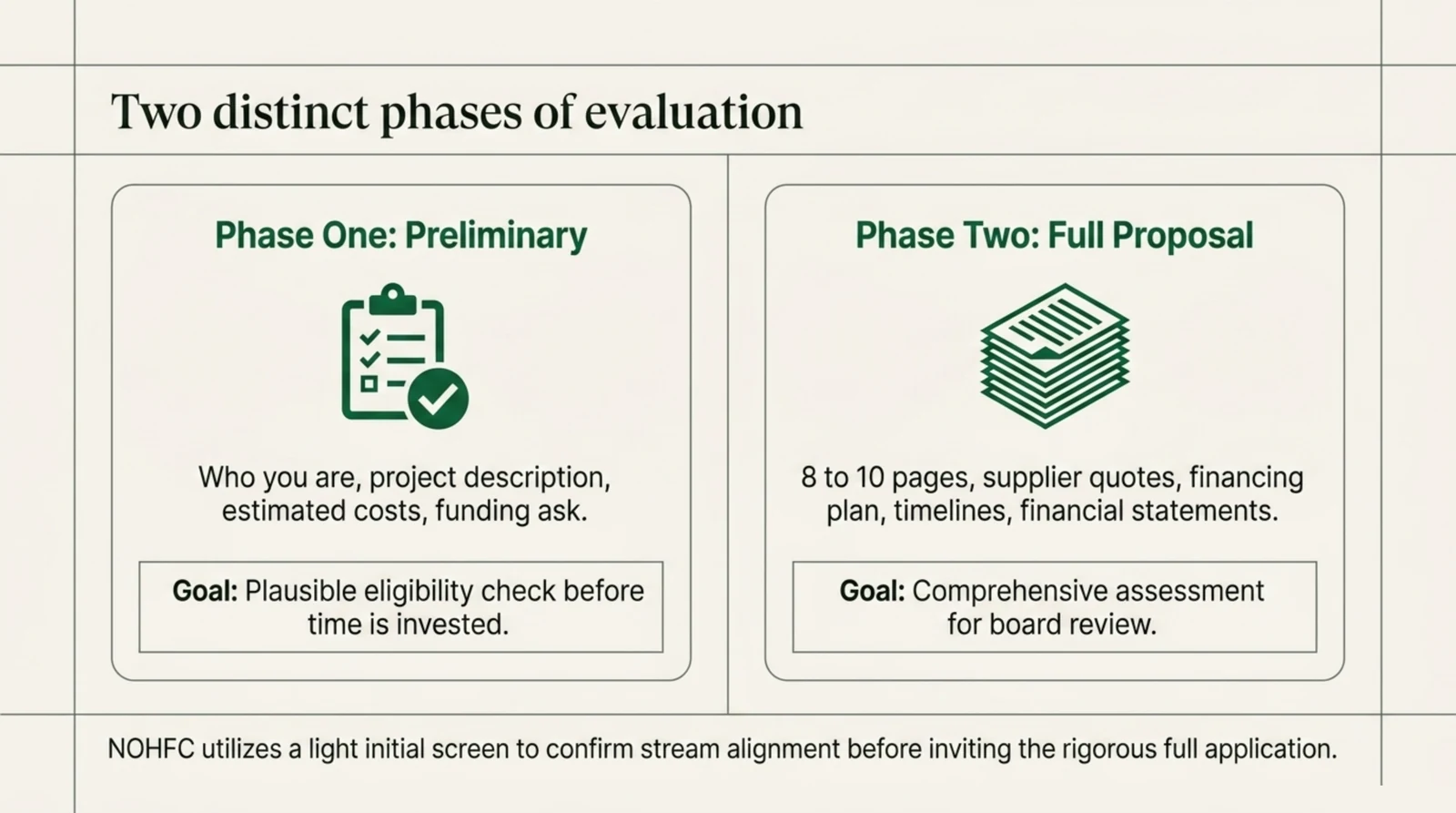
You submit the preliminary application through NOHFC's online portal, reached from nohfc.ca. It is a short form: who you are, what the project is, roughly what it costs, how much you are asking for, and what other funding you expect. NOHFC's initial screen of this form is reported to take about 10 business days.
Create an account, pick the funding stream that matches your project, and keep the answers factual. The preliminary stage is a screen, not the competition itself. Its job is to confirm that you and the project are plausibly eligible before anyone invests time in a full proposal.
Two practical points:
- Choose the stream carefully. A business expansion belongs in INVEST North: Grow, a brand-new operation in Launch, and a company establishing operations in Northern Ontario in Locate, which can provide up to $5 million as a conditional contribution. If you are unsure, say so or call NOHFC; staff will redirect you.
- Respond quickly to follow-up questions. The 10-business-day figure is reported for a clean submission; missing information stops the clock.
What does the assigned NOHFC program officer do?
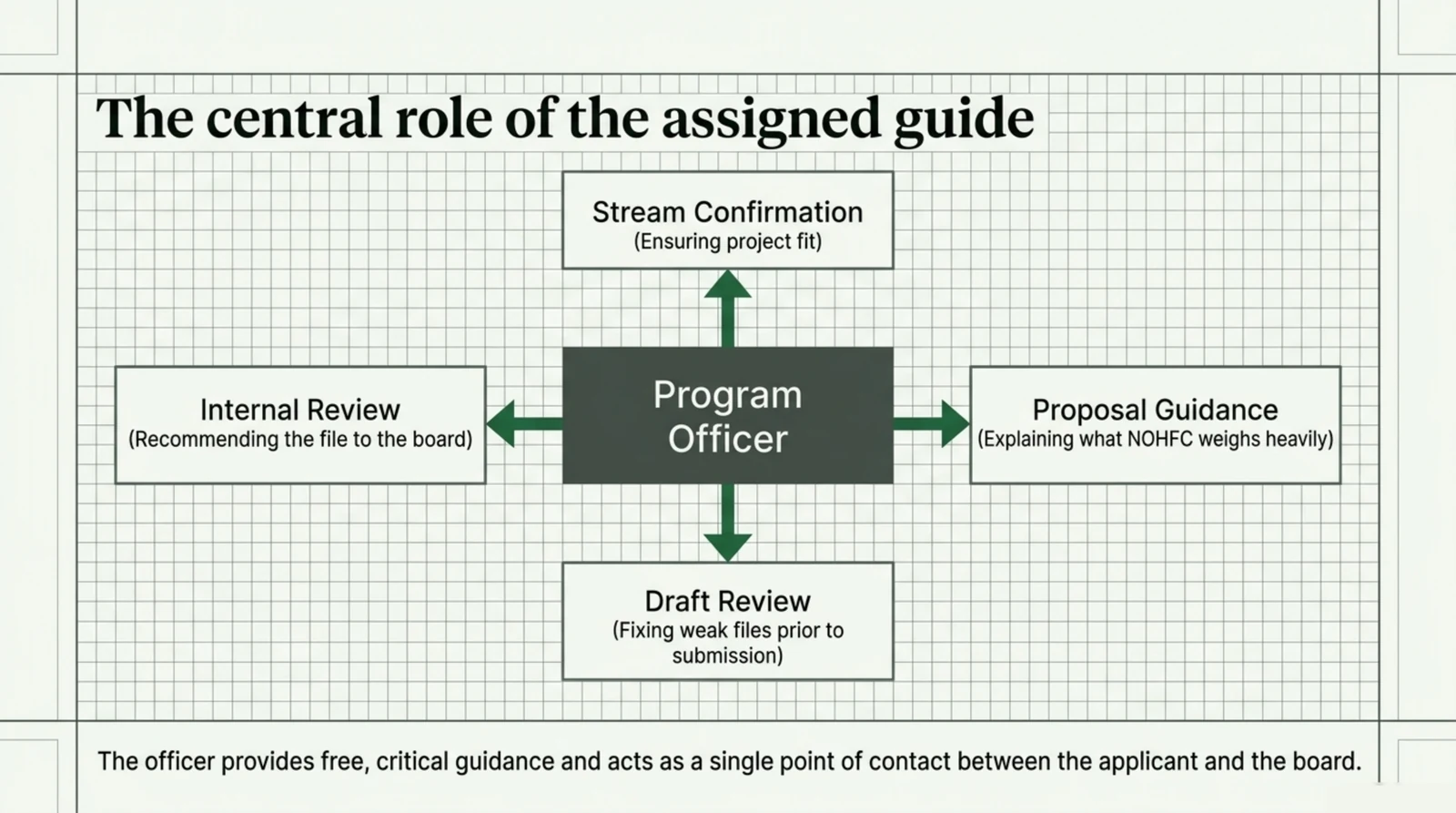
Once your preliminary application passes the screen, NOHFC assigns a program officer to your file. The officer is your single point of contact for the rest of the process: they confirm you are in the right stream, tell you what the full application must contain, review drafts, and eventually carry your file into internal review.
Use them. The officer's guidance is free, and it is the closest thing to an answer key you will get. Before you write the full proposal, ask what a strong application in your stream looks like, what evidence NOHFC weighs on job creation and economic impact, and what commonly sinks applications like yours. Officers would rather fix problems at the draft stage than watch a weak file go to review.
What goes into the full NOHFC proposal?
The full application is where the real work is. A proposal commonly runs 8 to 10 pages, plus attachments: a project budget backed by supplier quotes, a financing plan showing where every dollar comes from, a timeline, and financial statements. Business streams generally expect a business plan; community streams expect evidence of community support and of your capacity to complete the project.
Anchor the proposal to your stream's stated outcomes:
- Business streams such as Launch and Grow are assessed heavily on jobs created or retained and private investment leveraged, so make those numbers explicit and defensible.
- The Innovation Stream covers up to 50% of eligible costs to a maximum of $500,000 for developing and commercializing new technologies, so technical merit and a credible path to market carry weight.
- Community streams such as Rural Enhancement (capital repairs to community assets) and Community Events (up to 30% of eligible costs to a maximum of $15,000) turn on community benefit and a complete, realistic budget.
- Workforce streams such as Workforce Development and the Indigenous Workforce Development Stream centre on the position, the candidate pipeline, and retention.
How does NOHFC board approval work?
When staff are satisfied with your full application, they recommend it to the NOHFC board of directors, which makes the funding decision. The board meets periodically rather than continuously, so the time from a finished application to a decision depends partly on the meeting calendar. Your officer can tell you where your file sits and when the next relevant meeting falls.
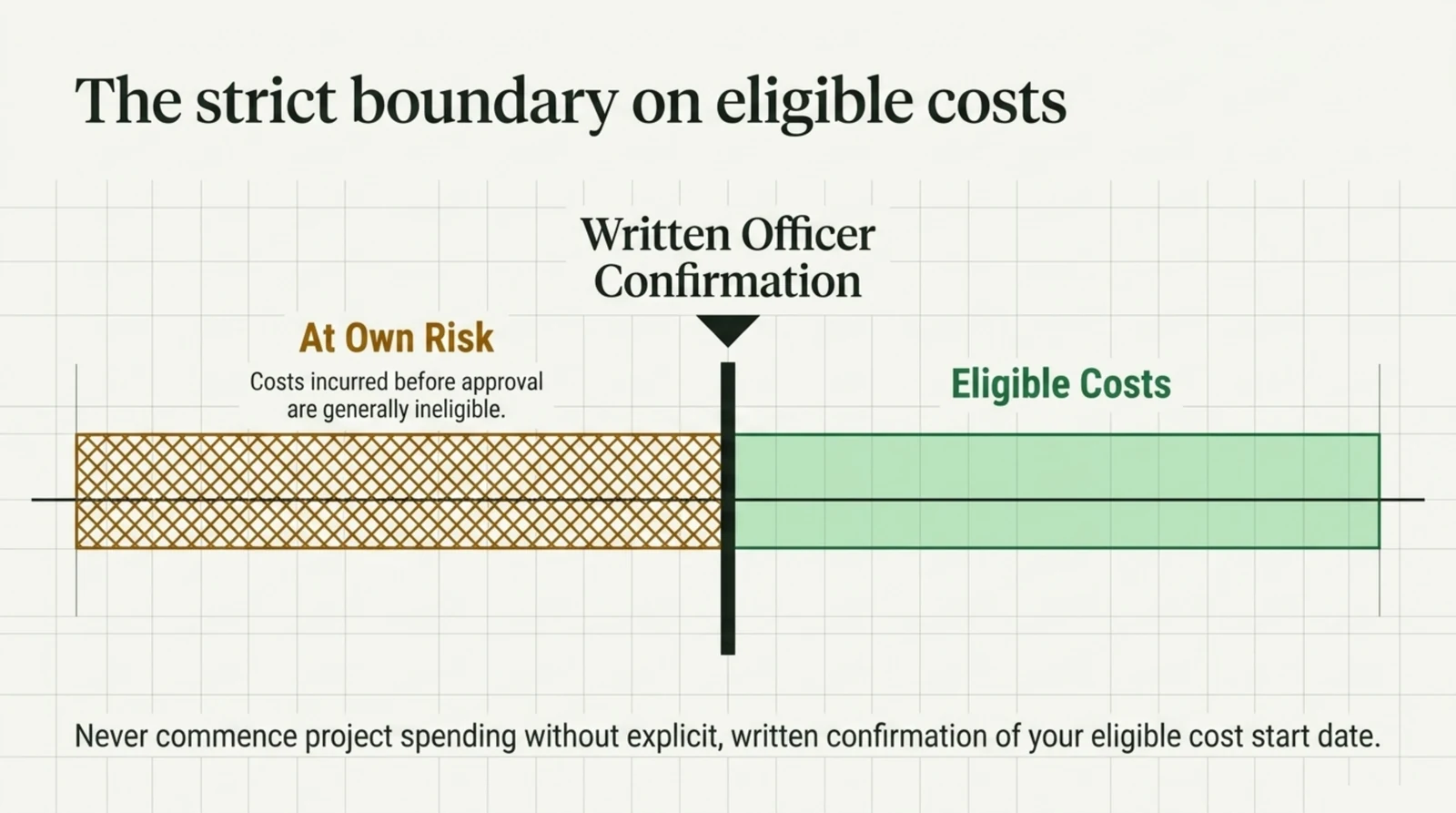
Do not start the project while you wait unless your officer has confirmed your eligible cost start date in writing. As a general rule, costs incurred before approval are at your own risk and are often ineligible. Verify your own file's position before committing money.
How long until the contract and the money arrive?
After board approval, the legal agreement is reported to take 6 to 8 weeks to arrive. Funding then flows on the contract's terms, typically as reimbursement of eligible costs you have paid and can document, sometimes with a holdback released at project completion. Build both realities into your cash flow: the wait for the contract, and the fact that you generally spend first and claim after.
End to end, a straightforward NOHFC file often takes several months from preliminary application to signed contract. Verify current service standards with NOHFC, and treat anything time-sensitive, such as construction seasons, hiring dates, or event dates for a Community Events application, as a reason to apply early.
How can you strengthen an NOHFC application?
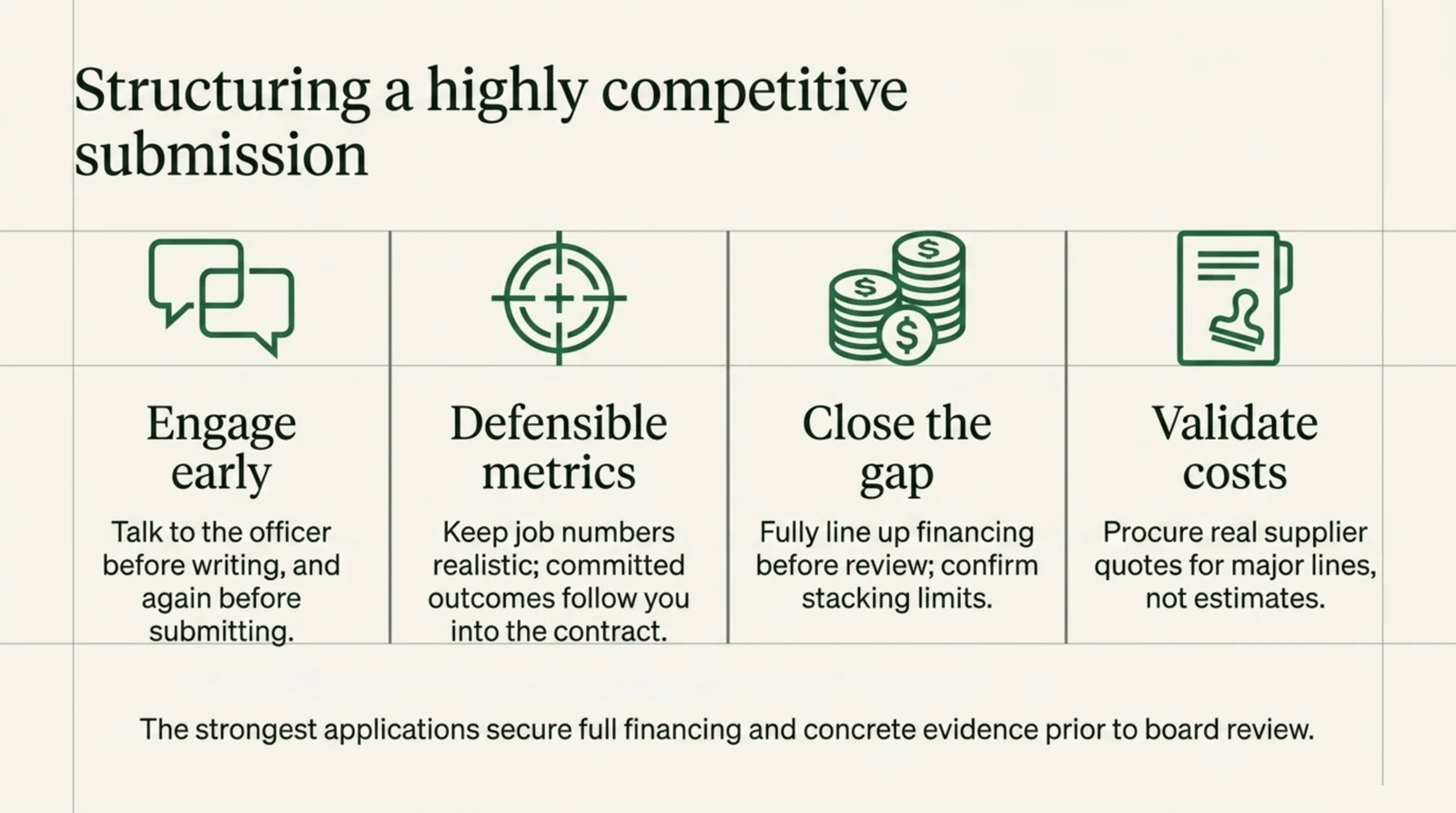
The strongest applications share the same habits: they engage the officer early, they promise outcomes they can prove, and their financing is fully lined up before the file goes to review.
- Talk to your officer before writing, and again before submitting.
- Keep job numbers realistic. Committed outcomes can follow you into the contract.
- Close the financing gap. NOHFC rarely funds everything; many projects stack NOHFC with federal support such as FedNor's Northern Ontario Development Program. Confirm stacking limits with your officer.
- Get real quotes, not estimates, for major cost lines.
- Do not pre-start the project without written confirmation of your eligible cost date.