How do you apply for an Ontario Trillium Foundation grant?
Updated Oct 1, 2026 · program facts link to dataset records
How does applying to OTF work?
Ontario Trillium Foundation (OTF) grants open in fixed application windows, generally announced annually for each grant type, rather than accepting applications year-round. You register your organization on OTF's granting portal, confirm eligibility, choose the grant that matches your project's stage, and submit before the deadline. Miss the window and you wait for the next one, so checking current deadlines on otf.ca is the genuine first step.
OTF is an agency of the Government of Ontario and one of the largest granters to the non-profit sector in the province. Its grants are competitive: meeting eligibility gets you assessed, not funded. The applications that succeed are specific about the community need, the result they will deliver, and how they will measure it.
When are the OTF application windows?
Each OTF grant type has its own scheduled deadline, historically announced for the year ahead on otf.ca, and applications are only accepted while a window is open. Deadlines are hard cut-offs, reported as closing at 5 p.m. Eastern time, and the portal does not take late submissions.
Two timing rules matter more than any specific date:
- Registration comes first. OTF has required organizations to complete portal registration and eligibility review in advance of the application deadline, with its own earlier cut-off. Register as soon as you know you intend to apply, not the week the application is due.
- Write before the window opens. The questions change little year to year, and OTF publishes guidance ahead of each deadline. Teams that draft early use the open window for refinement instead of a scramble.
Because dates change annually, verify the current calendar on otf.ca rather than relying on any republished list, including this one.
Is your organization eligible for OTF funding?
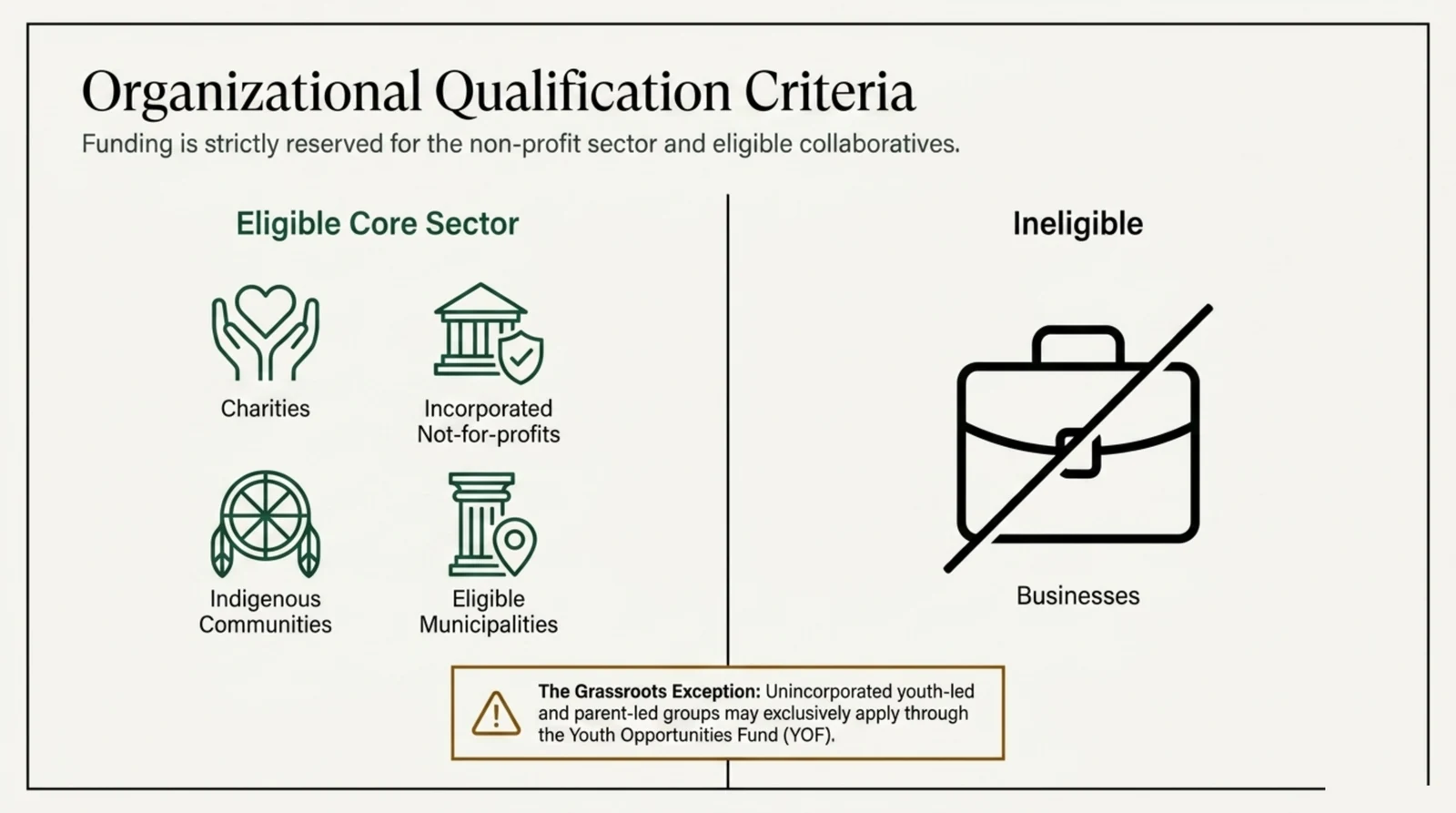
OTF funds the non-profit sector, not businesses. Eligible applicants generally include registered charities, incorporated not-for-profits, First Nations and other Indigenous communities, and some municipalities, with collaboratives able to apply through an eligible lead organization. Requirements such as minimum operating history and financial statements scaled to your revenue apply; verify the current rules on otf.ca before you invest time.
The notable exception to the incorporation rule is the Youth Opportunities Fund, which backs youth-led and parent-led grassroots groups across five streams, including unincorporated groups. If you are a small Northern Ontario collective without incorporation, that is the OTF door most likely to be open to you.
Which OTF grant matches your project?
Choose by project stage, not by dollar amount. OTF's investment streams map to a lifecycle: test a new idea, scale a proven one, or fix and equip the space you deliver it in. Applying to the wrong stream is one of the most common and most avoidable reasons files fail.
- Seed Grants: for piloting a new idea or building organizational capacity. Amounts have historically run up to about $75,000 over roughly a year; verify current figures with OTF.
- Grow Grants: for scaling a program you can already prove works, at $100,000 to $600,000 over 2 to 3 years ($50,000 to $200,000 per year). Evidence that the program is running and delivering results is the heart of this application.
- Capital Grants: for repairs, renovations, and equipment in community spaces. Amounts have historically reached about $150,000; verify current limits. This is the stream with the heaviest documentation load, covered below.
- Youth Opportunities Fund: for youth-led and parent-led grassroots projects, with its own streams, timelines, and supports.
What documents and evidence do you need?
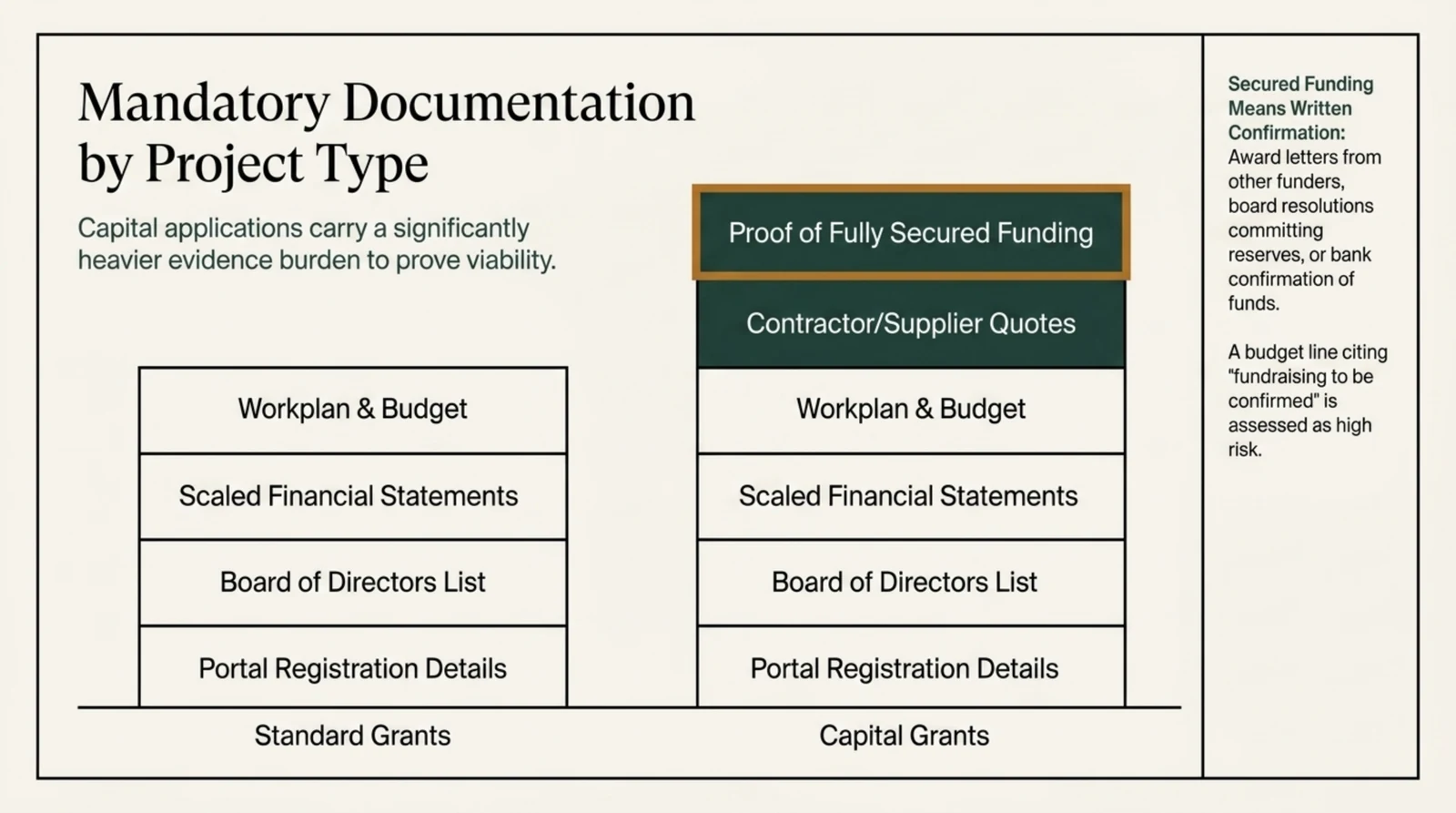
Expect to provide your organization's registration details, a board of directors list, financial statements matching OTF's requirements for your revenue level, a workplan, and a budget. Capital applications additionally require contractor or supplier quotes and proof that the rest of the project's money is secured. Gather these before the window opens; several take weeks to produce.
Two items deserve particular care:
- Secured-funding documentation. For capital projects especially, OTF expects the project to be fully funded, with its grant closing a defined gap. That means written confirmation of every other source: award letters from other funders, board resolutions committing reserves, or bank confirmation of funds. A budget line that says "fundraising, to be confirmed" reads as risk.
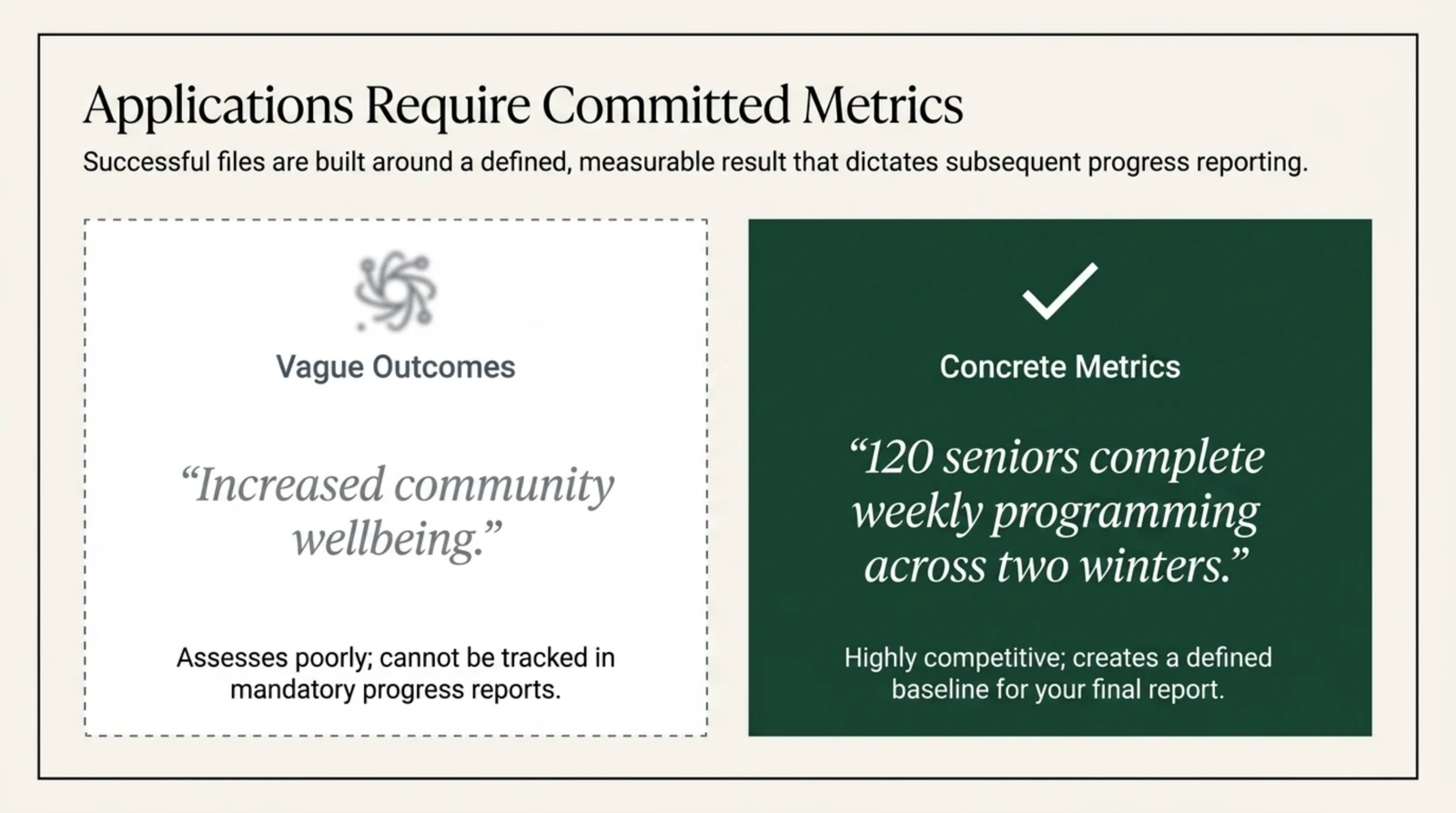
- A measurable grant result. OTF applications are built around a defined result with metrics you commit to reporting against. Vague outcomes ("increased community wellbeing") assess poorly next to concrete ones ("120 seniors complete weekly programming across two winters").
What happens after you submit to OTF?
Your application goes through eligibility checks and competitive assessment, and decisions are typically communicated a few months after the deadline; verify current review timelines with OTF. If approved, you sign a grant agreement, and payments are tied to the agreement and your reporting obligations, including progress reports and a final report against your stated metrics.
If you are declined, ask for feedback and treat it seriously. OTF windows recur, and a file that failed on evidence or an overbuilt budget can genuinely compete the following year. Many funded organizations were not funded on their first attempt.
What if OTF is not the right fit right now?
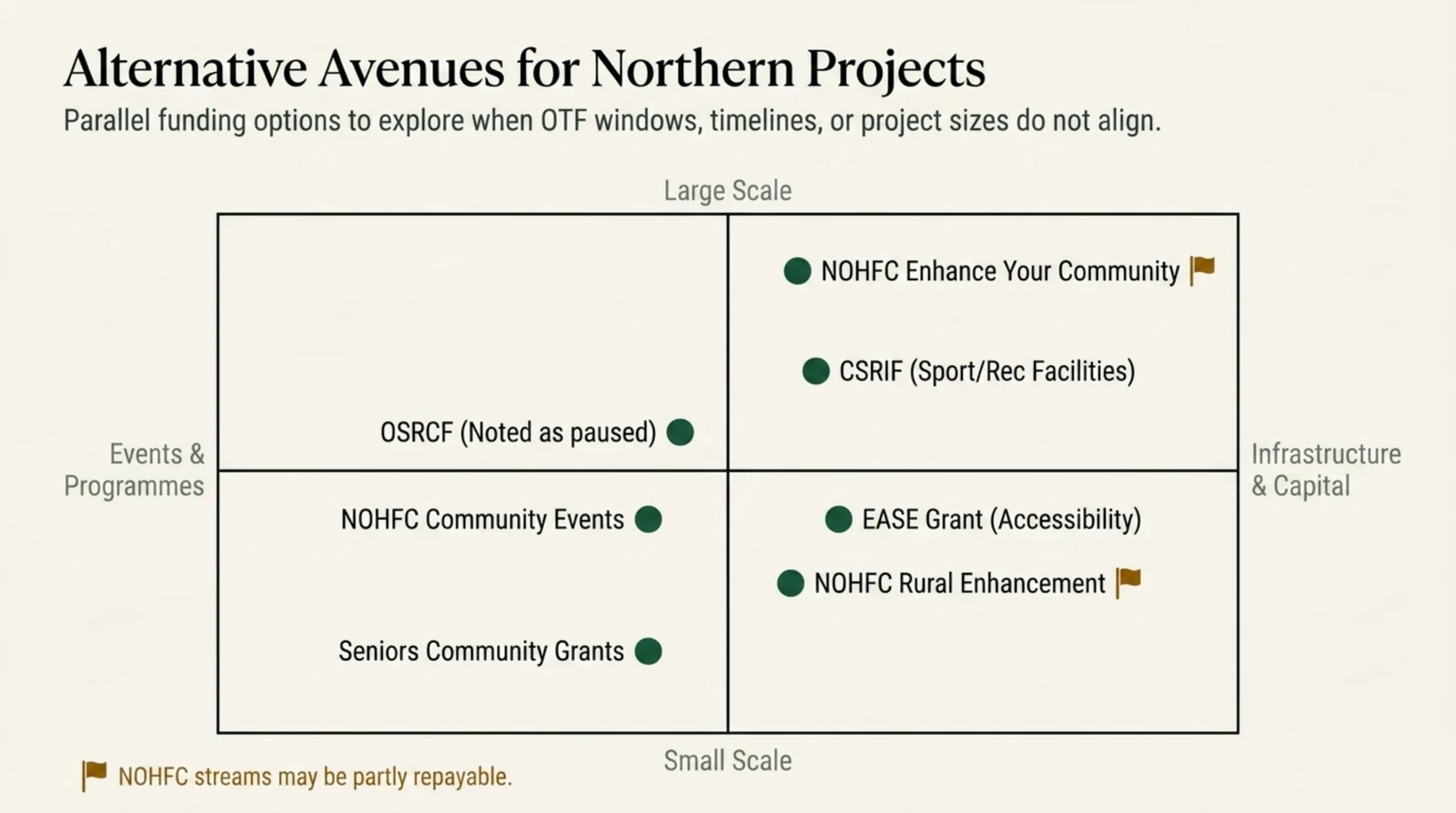
If your timeline, size, or project type does not match an OTF window, Northern Ontario community projects have parallel options worth checking before you force a fit.
- NOHFC's Enhance Your Community and Rural Enhancement fund community infrastructure and capital repairs.
- NOHFC Community Events supports festivals and events at up to 30% of eligible costs to a maximum of $15,000.
- Seniors Community Grants fund $1,000 to $25,000 projects for adults 55 and over, and unincorporated groups can access up to $10,000 via an individual applicant.
- The EASE Grant funds accessibility upgrades to community spaces at up to $60,000.
- For sport and recreation, note that OSRCF had no open intake as of August 2026, and CSRIF is the capital-side fund for facilities; check current status on both.