Is there free money to start a business in Northern Ontario?
Updated Oct 1, 2026 · program facts link to dataset records
The honest answer
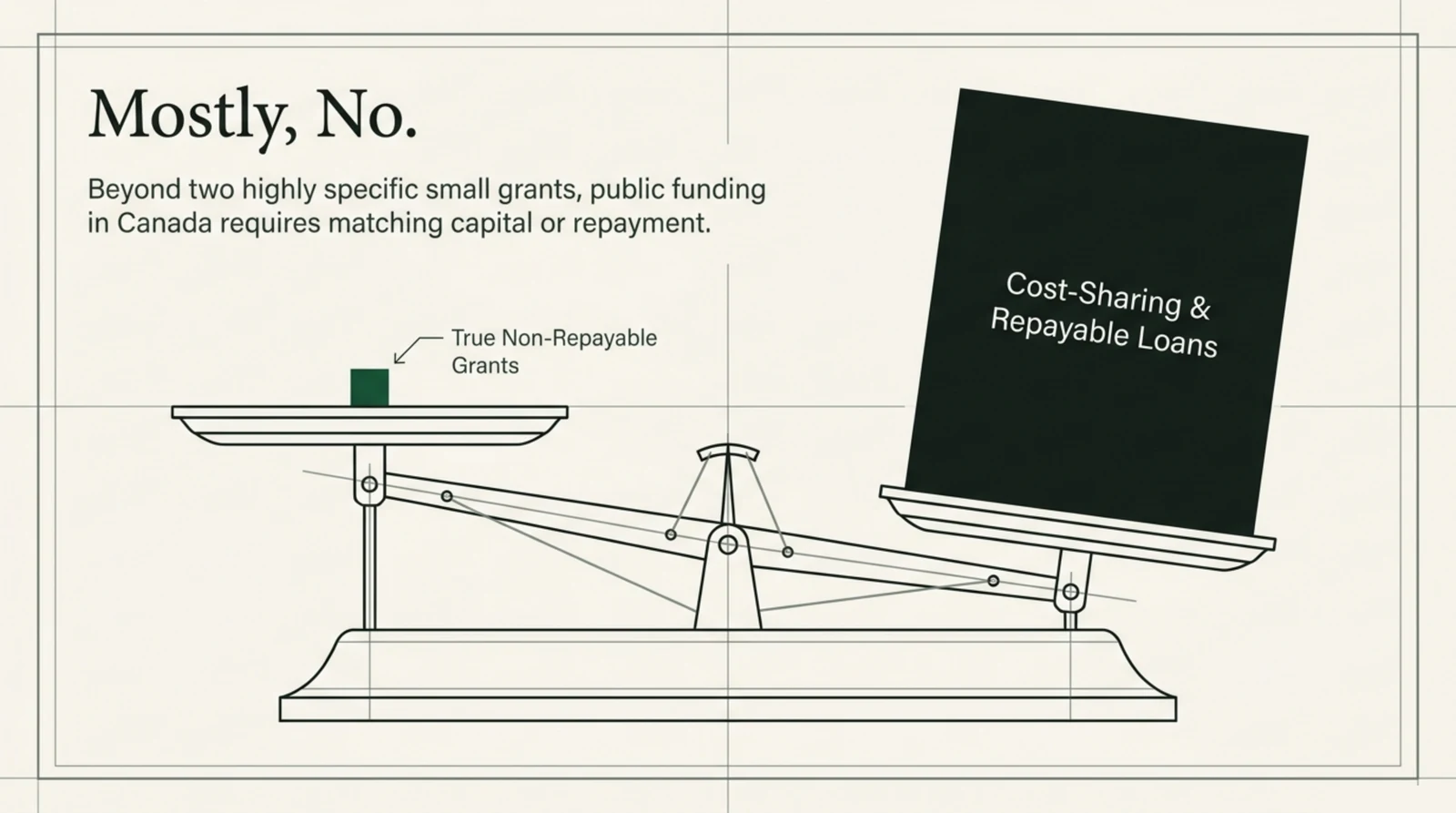
Mostly, no. For a typical new business owner in Northern Ontario there are exactly two small grants that hand you money to start: Starter Company Plus, worth up to $5,000, and Summer Company, worth up to $3,000 for students. Everything else on offer is either a repayable loan, a subsidy that reimburses part of what you have already spent, or a program that requires matching money of your own. The one significant exception is Indigenous entrepreneurship funding, where genuinely non-repayable contributions exist at meaningful scale.
That is not a reason to give up on funding. It is a reason to plan for it correctly: budget your own contribution, expect reimbursement rather than an upfront cheque, and treat any advertisement promising free government money for any business as a sales pitch, not a program.
What grants actually exist for starting a business?
Two provincial programs give real, non-repayable cash to new entrepreneurs, both delivered locally through Small Business Enterprise Centres.
Starter Company Plus combines business training and mentorship with a grant of up to $5,000 for adults 18 and over who are not in school full-time, whether starting, expanding, or buying a business. You must contribute some of your own money toward the business; the required share varies by delivery site, so confirm it with your local centre. In Timmins the program is delivered by The Business Enterprise Centre as its own local intake.
Summer Company pays students aged 15 to 29 up to $3,000 to launch and run a real summer business: up to $1,500 up front for start-up costs and up to $1,500 on completing the program, with mentoring built in. Timmins students apply through the local delivery.
Both are competitive programs with training obligations attached, not entitlements. A weak application gets declined, and the grant is paid on the program's schedule, not yours.
Why does everything else need matching money?
Because public business funding in Canada is built as cost-sharing, not gifting. Funders such as NOHFC and FedNor structure support as conditional contributions: they pay a percentage of eligible project costs after you incur them, and the contribution stays non-repayable only while you meet the conditions of your agreement. Your matching share is the program's evidence that you believe in the project enough to risk your own money on it.
Three consequences for a start-up:
- You spend first. Contributions are typically claimed against invoices you have already paid, so you need working capital or a loan to bridge the gap.
- Maximums are not typical awards. A program advertising a large ceiling funds most projects well below it.
- Brand-new businesses fit poorly. Programs such as NOHFC's Launch stream exist for new and early-stage businesses in Northern Ontario, but support is structured as cost-shared contributions rather than upfront cash; check NOHFC's current terms for what share and which costs qualify.
What about Indigenous entrepreneurs?
This is where real non-repayable money exists. Indigenous entrepreneurs in Northern Ontario have access to equity contributions that most other founders do not, delivered through Indigenous financial institutions.
- Waubetek's Business Financing Program provides conditional contributions of up to $99,999 in North-Eastern Ontario, as the regional delivery of the federal Aboriginal Entrepreneurship Program.
- NADF's E-Commerce Grant gives up to $8,000 in non-repayable funding to Indigenous entrepreneurs and majority Indigenous-owned businesses in NADF's service area.
- NADF's Indigenous Women Entrepreneurship program supports Indigenous women aged 18 and over who own at least 51 per cent of a business; support levels vary, so confirm current amounts with NADF.
- Waubetek's Indigenous Women's Entrepreneurship funds include a micro-loan of up to $20,000 structured as 45 per cent non-repayable, 50 per cent repayable, and 5 per cent cash equity.
- The Métis Voyageur Development Fund lends up to $1,500,000 to for-profit businesses anywhere in Ontario where a Métis owner holds at least 50 per cent.
The federal umbrella behind much of this is the Aboriginal Entrepreneurship Program, whose Access to Capital stream flows through NACCA to local Indigenous financial institutions. Even here, expect a business plan, a personal contribution, and due diligence; non-repayable does not mean unconditional.
Are loans worth taking instead?
Usually, yes. For most Northern Ontario start-ups a loan is the realistic main source of capital. The region's 24 Community Futures Development Corporations offer repayable business loans, loan guarantees, and equity investments, commonly up to $150,000. CFDCs lend where banks often will not: rural markets, first-time owners, seasonal businesses. Through FedNor's Community Futures Program they are also the standing front door for small-business support in most rural communities, so the loan conversation doubles as a funding-navigation conversation.
For women entrepreneurs, PARO's Peer Lending Circles approve loans of $1,000 to $5,000 through a self-selected circle of four to seven women who meet regularly for support. The amounts are small, but repayment builds a credit record and the circle provides the peer network most solo founders lack.
A repayable dollar you can actually get this quarter is worth more than a non-repayable dollar you cannot. Loans also stack with the grants above: a CFDC loan can supply the contribution a cost-shared program requires.
How do you spot 'free government money' claims that are not real?
Watch for four patterns. Companies that charge a fee to send you a list of grants are selling what this site and every funder publish free. Anyone guaranteeing approval is misleading you, since every real program is discretionary. Advertisements citing unnamed programs that pay thousands to anyone who applies do not survive contact with an actual program guide. And services offering to apply on your behalf for a percentage of the award are usually recycling the same public application forms you could complete yourself.
The reliable check is always the same: find the program on the funder's own website, read its guidelines, and call the delivery organization. Every legitimate program in this guide is free to apply to, and the delivery staff answer questions without charge.