How do Northern Ontario students stack OSAP Distance Grants and Learn and Stay?
Updated Oct 1, 2026 · program facts link to dataset records
What extra money exists for Northern Ontario students?
Three provincial supports matter most. OSAP's Distance Grants add flat grant money when your permanent home is 80 kilometres or more from the closest college or university of the type you attend. The Ontario Learn and Stay Grant pays full upfront costs for eligible health programs in exchange for working in the region after graduation. And the Ontario Indigenous Travel Grant supported travel from remote First Nations, though its current status should be verified.
Layered on top are summer programs that put money in your pocket between terms. None of these replace the standard OSAP application; most of them run through it. The stack works because each piece targets a different cost: distance, tuition, travel, and summer income.
Do you qualify for the OSAP Distance Grants?
You qualify when your permanent home is 80 kilometres or more from the closest college or university of the type you attend, a test much of Northern Ontario passes automatically. The grants are flat amounts added to your OSAP funding, and they are reported to be assessed from your standard OSAP application with no separate form. Details are on our Distance Grants page.
Read the rule carefully: the measurement is to the closest institution of that type, not to the school you actually chose. A student from Hearst, Marathon, or Red Lake is more than 80 kilometres from any university, so they qualify wherever they enrol. A Thunder Bay student attending Lakehead does not, because a university sits in their home city; the same student attending college would be measured against Confederation College, also local. The grant compensates for having no nearby option, not for choosing a distant one.
The amounts are flat and modest rather than need-scaled, and they change over time; verify the current rates on the OSAP site rather than relying on any figure quoted secondhand.
What does the Learn and Stay Grant actually pay?
Learn and Stay pays your full upfront costs: tuition, compulsory fees, books, and supplies. Those categories are verified. It applies to eligible nursing, practical nursing, nurse practitioner, paramedic, and medical laboratory technology programs in priority regions, and Northern Ontario is among them. In exchange, you commit to working in the region for a set period after graduating. Details are on our Learn and Stay page.
For a northern student who already plans to build a career at home, this is the largest grant on the table by a wide margin, because it covers full costs rather than topping them up. The trade is real, though: the return-of-service commitment is a binding agreement, the eligible program and region combinations change by intake year, and leaving the region early is reported to convert the support into a repayable amount. Read the agreement before you sign, and verify the current program list and service terms for your intake year.
You apply through the standard OSAP application, selecting the grant. Application windows follow the academic year; check the deadlines for your start date.
Can you stack Distance Grants, Learn and Stay, and regular OSAP?
Generally, yes. The Distance Grants are components of your OSAP assessment, Learn and Stay runs through the same OSAP application as a distinct grant, and you can hold regular OSAP loans and grants for living costs alongside Learn and Stay's coverage of educational costs. The pieces are designed to coexist rather than compete.
How they interact inside your individual assessment can still vary, and receiving one support can affect the calculation of others. Verify your complete package with your school's financial aid office once your OSAP estimate arrives, before you make housing or travel commitments based on it.
What about the Ontario Indigenous Travel Grant?
The Ontario Indigenous Travel Grant covered travel between remote Zone 3 and Zone 4 First Nations communities and postsecondary institutions, historically at $1,300 per one-way trip. Its current status is unclear as of August 2026, so verify with the ministry or your education counsellor before building it into your budget.
Whether or not the provincial grant is taking applications, students from First Nations communities should also ask their band education office what post-secondary supports exist, including travel funding administered at the community level. Those supports run on their own rules and are often the faster route.
How do you fund the summers?
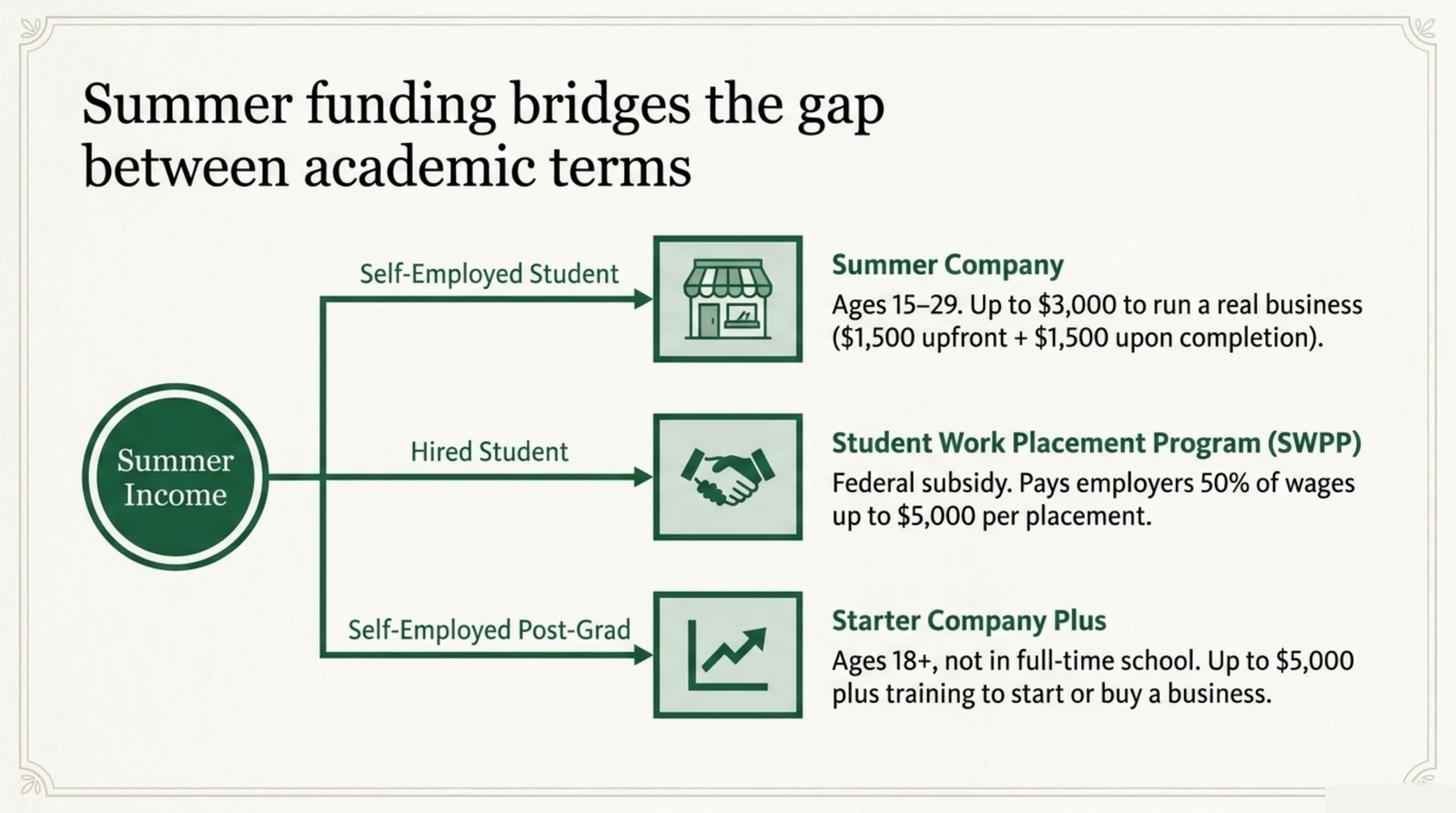
Two Ontario programs pay students to run a summer business, and one federal subsidy makes you cheaper to hire. Summer Company pays students aged 15 to 29 up to $3,000 to start and run a real summer business: up to $1,500 up front for start-up costs and up to $1,500 on completing the program, with mentorship included. In Timmins it is delivered locally by The Business Enterprise Centre; see the Timmins delivery.
If you would rather be hired than self-employed, the Student Work Placement Program subsidizes employers who hire post-secondary students into placements related to their studies, reported at 50% of wages up to $5,000 per placement as of summer 2026 (the former $7,000 tiers were reduced). Employers often do not know it exists, so mentioning it in your application can tip a hiring decision.
After graduation, the entrepreneurial route continues: Starter Company Plus offers adults 18 and over who are not in school full-time a grant of up to $5,000 plus training to start, expand, or buy a business.